Key Takeaways
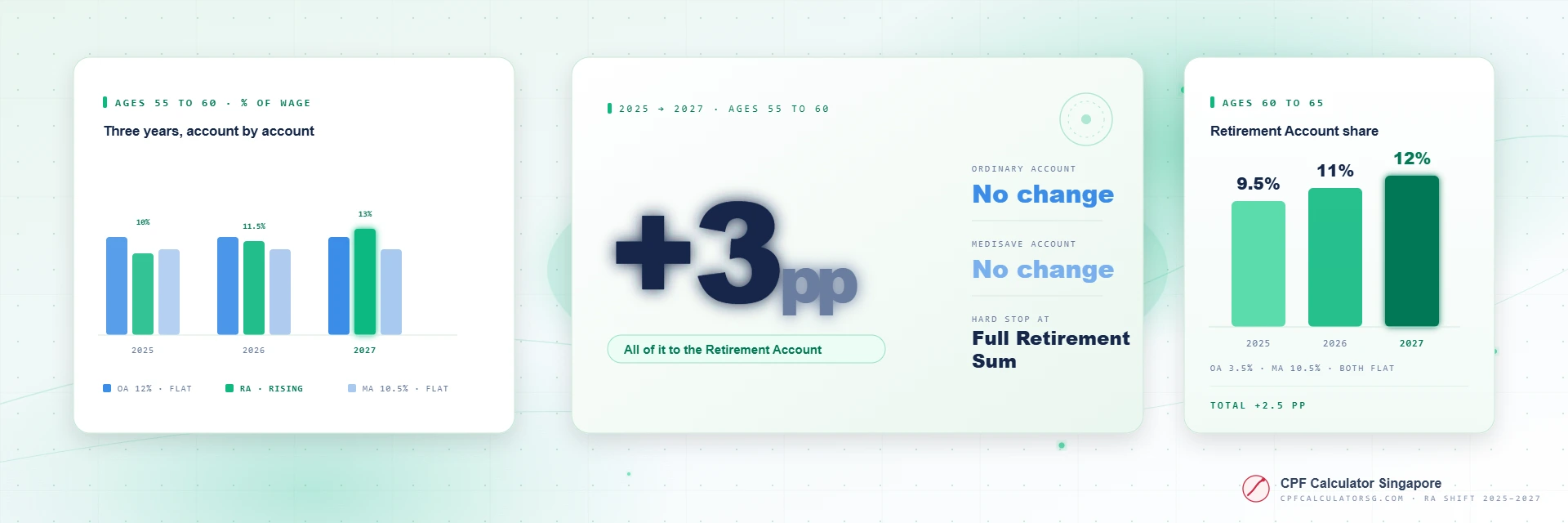
- Senior worker CPF rates rose in 2025, 2026 and again in 2027. Every one of those increases went to the Retirement Account.
- Ordinary Account and MediSave allocations for ages 55 to 65 have not moved by a single decimal place across all three years.
- For ages 55 to 60 the Retirement Account share went from 10% of wages to 13%. For 60 to 65 it went from 9.5% to 12%.
- The push has a hard stop: once you have set aside your Full Retirement Sum, further contributions go to your Ordinary Account instead.
- This page explains the trade-offs. It does not tell you what to do with your own money.
Singapore has raised CPF contribution rates for workers aged 55 to 65 three years running. Each announcement was reported as a rate change. Read the allocation tables published alongside them and a more specific policy shows up: the rate changes are a Retirement Account policy, and nothing else in the allocation moved at all.
The Three-Year Pattern
CPF Board publishes allocation as a ratio of the total contribution. Convert those ratios into a share of wages for each of the three published years and set them side by side.
| Age Group | Goes To | 2025 | 2026 | 2027 | Change 2025–2027 |
|---|---|---|---|---|---|
| Above 55 to 60 | Ordinary Account | 12% | 12% | 12% | No change |
| Retirement Account | 10% | 11.5% | 13% | +3 pp | |
| MediSave Account | 10.5% | 10.5% | 10.5% | No change | |
| Total contribution | 32.5% | 34% | 35.5% | +3 pp | |
| Above 60 to 65 | Ordinary Account | 3.5% | 3.5% | 3.5% | No change |
| Retirement Account | 9.5% | 11% | 12% | +2.5 pp | |
| MediSave Account | 10.5% | 10.5% | 10.5% | No change | |
| Total contribution | 23.5% | 25% | 26% | +2.5 pp |
The Ordinary Account line is flat. The MediSave line is flat. Only the Retirement Account moves, and it moves by exactly the amount the total contribution moved — 3 percentage points for 55 to 60 across the three years, and 2.5 points for 60 to 65.
The totals those allocations sit inside:
| Age Group | 2025 | 2026 | 2027 | Change |
|---|---|---|---|---|
| 55 & below | 37% | 37% | 37% | No change |
| Above 55 to 60 | 32.5% | 34% | 35.5% | +3 pp |
| Above 60 to 65 | 23.5% | 25% | 26% | +2.5 pp |
| Above 65 to 70 | 16.5% | 16.5% | 16.5% | No change |
| Above 70 | 12.5% | 12.5% | 12.5% | No change |
In Dollars, for Two Workers
Percentages understate this. These are two workers on unchanged salaries, with their monthly contributions and account allocations computed for each year under CPF Board’s rounding rules.
| Worker | Account | 2025 | 2026 | 2027 | Change |
|---|---|---|---|---|---|
| Age 57, $6,000 a month | Ordinary Account | $720.33 | $720.12 | $720.37 | No change (rounding) |
| Retirement Account | $599.82 | $689.93 | $779.79 | +$179.97 | |
| MediSave Account | $629.85 | $629.95 | $629.84 | No change (rounding) | |
| Total contribution | $1,950 | $2,040 | $2,130 | +$180 | |
| Age 62, $4,500 a month | Ordinary Account | $157.65 | $157.50 | $157.59 | No change (rounding) |
| Retirement Account | $427.64 | $495 | $539.96 | +$112.32 | |
| MediSave Account | $472.71 | $472.50 | $472.45 | No change (rounding) | |
| Total contribution | $1,058 | $1,125 | $1,170 | +$112 |
The 57-year-old’s Ordinary Account receives essentially the same amount in 2027 as it did in 2025 — the few cents of movement are rounding, since the Ordinary Account takes whatever remains after MediSave and the Retirement Account are computed. The Retirement Account is where the entire three-year increase went.
Is This Deliberate?
CPF Board says so directly. Its announcement of the 2027 changes states that the increase for employees aged above 55 to 65 “will be fully allocated to the Retirement Account (RA), up to their Full Retirement Sum (FRS)”, and gives the reason as strengthening retirement adequacy.
The mechanism reinforces it. Since the Special Account closed for members aged 55 and above, there is no Special Account to receive contributions in these age bands; the choice is between the Ordinary Account and the Retirement Account, and the increases have gone to the Retirement Account every time.
The Ceiling on the Push
This is the part that gets lost in the headline. The routing to the Retirement Account is capped at your Full Retirement Sum. CPF Board’s wording is explicit: if members have already set aside their Full Retirement Sum in their Retirement Account, the contributions are channelled to the Ordinary Account instead.
So two 57-year-olds on identical salaries can experience the 2027 increase in completely different ways. The one still below their Full Retirement Sum sees the extra money locked into an account that pays out from 65. The one who has already met it sees the extra money land in an Ordinary Account they can use for a mortgage, or withdraw above the Full Retirement Sum once they turn 55.
And the target moves. The Full Retirement Sum rises each year for each new cohort turning 55:
| Retirement Sum | Turning 55 in 2026 | Turning 55 in 2027 | Increase |
|---|---|---|---|
| Basic Retirement Sum (BRS) | $110,200 | $114,100 | +$3,900 |
| Full Retirement Sum (FRS) | $220,400 | $228,200 | +$7,800 |
| Enhanced Retirement Sum (ERS) | $440,800 | $456,400 | +$15,600 |
Ordinary Account and Retirement Account Are Not Interchangeable
Because the policy pushes money from one account into another, it is worth being precise about how the two differ. This is a description of the rules, not a recommendation.
| Ordinary Account | Retirement Account | |
|---|---|---|
| Base interest | 2.5% a year | 4% a year |
| Extra interest at 55 and above | An extra 2% a year on the first $30,000 of combined balances and an extra 1% on the next $30,000, with at most $20,000 of that counted from the Ordinary Account | |
| Can be used for housing | Yes | No |
| Can be withdrawn at 55 | Yes, above the Full Retirement Sum | No, beyond the withdrawal rules at 55 |
| Turns into monthly payouts | No | Yes, through CPF LIFE from 65 |
| Reversible | Transfers from the Ordinary Account to the Retirement Account cannot be undone | |
The Separate Question: Should You Move More Yourself?
The allocation shift described above is mandatory. You do not choose it and you cannot opt out of it. It is worth separating that from a decision you do control: whether to voluntarily top up or transfer additional money into your Retirement Account.
People reading about the Retirement Account push sometimes conclude they should lean into it. Others conclude the opposite — that with more of their mandatory contribution already locked away, they want their discretionary savings kept liquid. Both are coherent. The considerations that actually decide it:
- Whether you need your Ordinary Account for housing. Money moved to the Retirement Account cannot service a mortgage. For anyone with an outstanding housing loan, this is usually the binding constraint.
- Whether the move is reversible. Ordinary Account to Retirement Account transfers are one-way and permanent. That is the single most important asymmetry in the decision.
- The interest difference. Roughly 1.5 percentage points a year on the base rates, more once the extra interest tiers are counted. Compounded over a decade this is substantial — but it is earned on money you cannot reach.
- Your emergency buffer outside CPF. CPF interest is irrelevant if a cash shortfall forces you into higher-cost borrowing.
- Where you stand against the Full Retirement Sum. Below it, further contributions keep flowing to the Retirement Account automatically. At or above it, they do not.
- Tax relief on cash top-ups, which applies to top-ups of your own or family members’ accounts, subject to the prevailing caps and conditions.
We deliberately do not publish a recommendation on this. The right answer depends on your housing commitments, your liquidity outside CPF, your health, and your retirement timing — none of which a web page knows. If you want to think it through by age band, our CPF top-up strategy by age and OA, SA and MA top-up priority guides lay out the mechanics in more detail.
What to Watch Next
The senior worker increases to date have followed a consistent shape: 1.5 percentage points a year for the 55 to 60 band, with the employee carrying two thirds of it and the employer one third, routed entirely to the Retirement Account. Whether that continues past 2027 has not been published. When CPF Board releases the tables, they will appear here with the same treatment.
This page is a reference, not financial advice. It sets out what the published rates are and how they are calculated. What to do about your own CPF depends on circumstances this page knows nothing about.
Frequently Asked Questions
Where do CPF contribution rate increases for older workers go?
Entirely to the Retirement Account. Across the 2025, 2026 and 2027 increases, the Ordinary Account and MediSave allocations for ages 55 to 65 did not change at all. For ages 55 to 60 the Retirement Account share rose from 10% of wages in 2025 to 11.5% in 2026 and 13% in 2027; for 60 to 65 it rose from 9.5% to 11% to 12%.
Does the Singapore government want people to put more into their Retirement Account?
CPF Board states that the increase in contributions for employees aged above 55 to 65 is fully allocated to the Retirement Account, up to the Full Retirement Sum, in order to strengthen retirement adequacy. Three consecutive years of increases have been routed this way, with no change to Ordinary Account or MediSave allocations.
What happens once I reach the Full Retirement Sum?
The routing stops. CPF Board states that if members have already set aside their Full Retirement Sum in their Retirement Account, the additional contributions are channelled to their Ordinary Account instead. Ordinary Account savings can be used for housing and, above the Full Retirement Sum, withdrawn from age 55.
Should I transfer more money from my OA to my RA?
That depends on circumstances this page cannot know, and we do not publish a recommendation. The factors that decide it are whether you need your Ordinary Account for housing, that OA-to-RA transfers are permanent and cannot be reversed, the roughly 1.5 percentage point interest difference on money you cannot access until 65, your cash savings outside CPF, and where you stand against the Full Retirement Sum.
Can I reverse a transfer from my Ordinary Account to my Retirement Account?
No. Transfers from the Ordinary Account to the Retirement Account are irreversible. This is the main reason the decision deserves more care than the interest rate difference alone suggests.
Why did my Ordinary Account allocation not increase along with my CPF rate?
Because the increases were designed to go to the Retirement Account only. Your Ordinary Account receives the same percentage of your wage in 2027 as it did in 2025 — 12% for ages 55 to 60 and 3.5% for ages 60 to 65 — while the Retirement Account absorbed every increase.