Key Takeaways
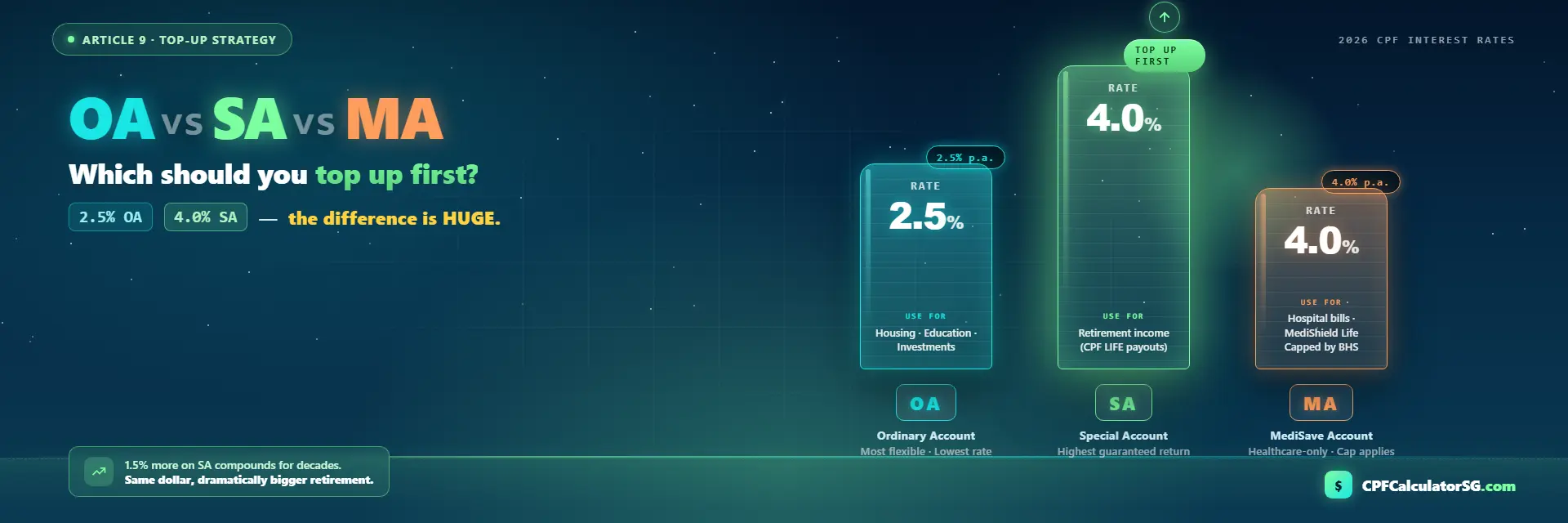
- SA earns 4% p.a. versus OA's 2.5% — the gap compounds over 20 years or more
- Cash top-ups to SA (before 55) or RA (after 55) qualify for income tax relief up to $8,000/year for yourself and $8,000/year for family members
- MediSave top-ups are also tax-deductible, but only up to the Basic Healthcare Sum cap of $79,000 in 2026 — once you hit BHS, top-ups provide no compounding benefit
- OA-to-SA transfers are irreversible — consider housing plans carefully before doing this
- One common order for people without near-term housing needs: SA first, then MA to BHS, then OA kept for housing. Your own order depends on your age, tax rate and housing plans
A Quick Recap: What Each Account Pays, and What a Top-Up Is Worth
| Account | Floor rate | Best rate below 55 | Best rate from 55 | What it is for | Cash top-up tax relief |
|---|---|---|---|---|---|
| Ordinary Account (OA) | 2.5% | 3.5% | 4.5% | Housing, education, insurance, approved investments | No — money paid into the OA is a voluntary contribution, not an RSTU top-up, and earns no relief |
| Special Account (SA) | 4% | 5% | — (closed from 55) | Retirement savings, until it closes at 55 | Yes — up to $8,000 a year for yourself and $8,000 for family, under RSTU |
| MediSave Account (MA) | 4% | 5% | 6% | Hospital bills, approved outpatient treatment, MediShield Life | Yes — a separate relief from RSTU, and only up to the Basic Healthcare Sum |
| Retirement Account (RA) | 4% | — (opens at 55) | 6% | The CPF LIFE payout from 65 | Yes — the same RSTU relief as the SA, $8,000 for yourself and $8,000 for family, from 55 |
The floor rate is the minimum CPF Board pays on that account. The two “best rate” columns add the extra interest, which is paid on your balances as a whole and not per account: below 55 an extra 1% on the first $60,000 of your combined balances, of which at most $20,000 may come from the OA; from 55 an extra 2% on the first $30,000 and 1% on the next $30,000 of your combined balances, of which at most $20,000 may come from the OA. Because the OA is filled first and capped inside that tranche, how much of the tranche your SA, MA or RA actually earns depends on your OA balance — there is no fixed dollar figure per account.
Source: CPF Board, cpf.gov.sg. Rates and relief limits on this page are generated from the site’s rate data file, not typed in.
What Limits Each CPF Account
The short answer: the Special Account has no limit on what it can hold. What is capped is what you can put into it — cash top-ups and OA-to-SA transfers stop once the account reaches the 2026 Full Retirement Sum of $220,400, and the account itself is closed for members aged 55 and above. The only CPF account with a limit on the balance is MediSave, at the 2026 Basic Healthcare Sum of $79,000. The Retirement Account takes top-ups up to the Enhanced Retirement Sum of $440,800.
“The SA limit” can mean three different things: a cap on what the account may hold, a cap on what you are allowed to pay in, and a cap on what earns income tax relief. They are different numbers, and only one CPF account has the first kind at all.
| Account | Limit on the balance | Limit on what goes in | The 2026 figure |
|---|---|---|---|
| Ordinary Account (OA) | None | Contributions are limited by the wage ceilings, not by the account: $8,000 of Ordinary Wage a month and $102,000 of total wage a year | OW ceiling $8,000 Annual ceiling $102,000 |
| Special Account (SA) | None | Cash top-ups under RSTU and OA-to-SA transfers both stop once the account reaches the Full Retirement Sum. The account is closed from 55. | FRS $220,400 |
| MediSave Account (MA) | Yes — the Basic Healthcare Sum, and it is the only CPF account with one | Contributions above the Basic Healthcare Sum overflow into the SA below 55, or the RA and then the OA from 55. Your BHS is frozen at the figure for the year you turn 65. | BHS $79,000 |
| Retirement Account (RA) | None | Top-ups stop at the Enhanced Retirement Sum, which is the ceiling in force that calendar year rather than a figure fixed to your cohort. Tax relief stops earlier, at the Full Retirement Sum. | ERS $440,800 Relief to FRS $220,400 |
Where the Money Actually Goes: OA, SA and MA Allocation Rates
The short answer: CPF Board publishes allocation as a ratio of your total contribution. Stated the way a payslip reads — as a percentage of wage — a member aged 35 and below in 2026 sends 23% of wage to the Ordinary Account, 6% to the Special Account and 8% to MediSave, which is the whole 37% contribution. The Ordinary Account’s share falls with every band; MediSave’s rises and then holds.
| Age Group | Ordinary (OA) | Special (SA) | MediSave (MA) | Retirement (RA) | Total |
|---|---|---|---|---|---|
| 35 & below | 23% | 6% | 8% | — | 37% |
| Above 35 to 45 | 21% | 7% | 9% | — | 37% |
| Above 45 to 50 | 19% | 8% | 10% | — | 37% |
| Above 50 to 55 | 15% | 11.5% | 10.5% | — | 37% |
| Above 55 to 60 | 12% | — | 10.5% | 11.5% | 34% |
| Above 60 to 65 | 3.5% | — | 10.5% | 11% | 25% |
| Above 65 to 70 | 1% | — | 10.5% | 5% | 16.5% |
| Above 70 | 1% | — | 10.5% | 1% | 12.5% |
Every row adds up to that band’s total contribution rate, because these are shares of your wage rather than CPF Board’s published ratios of the contribution. From 55 the Special Account is closed and its share goes to the Retirement Account. The bands here are the allocation bands, which are narrower than the five contribution bands. A per-age version of this table, one row for every age, is on the contribution rate by age reference.
To see where members your age actually stand first, the average CPF balance by age gives a per-group benchmark on CPF Board's published figures.
Which Account First? A Rule of Thumb
Do you plan to buy property in the next 3 years?
│
├─ YES → OA money is earmarked for housing, and a transfer to SA
│        cannot be undone. A small SA cash top-up from outside
│        CPF is still possible.
│
└─ NO → Is your MA below the BHS cap ($79,000 in 2026)?
         │
         ├─ YES → Top-ups can be split: SA for the relief and compounding,
         │         MA for the healthcare buffer. Both earn 4% and both get tax relief
         │
         └─ NO → SA is the usual next stop
                  MA is already at the cap; the excess moves out automatically
Why SA Usually Comes First
The Interest Rate Advantage
The 1.5 percentage point gap between OA (2.5%) and SA (4%) looks small. Over 20 years it adds up.
At the CPF Board rates as at 20 August 2026, $50,000 in OA at 2.5% for 20 years grows to approximately $82,000.
$50,000 in SA at 4% for 20 years grows to approximately $110,000.
That is $28,000 more — from the same starting amount, with no additional contributions, simply from the rate difference. The earlier you get money into SA, the longer this gap works in your favour.
The Tax Relief Advantage
Cash top-ups to SA (before age 55) qualify under the Retirement Sum Topping-Up (RSTU) Scheme:
- Self top-up: up to $8,000 in tax relief per year
- Top-up to family members (parents, in-laws, spouse, siblings): up to $8,000 in additional tax relief per year
- Maximum combined tax relief per year: $16,000
An $8,000 cash top-up reduces chargeable income by $8,000. On an income between $80,000 and $120,000 that is $920 of tax saved; at the top rate of 24%, above $1,000,000, it is $1,920. The saving is always the difference between the tax you would pay with the relief and without it, so a top-up that straddles two bands saves less than the higher rate alone suggests.
The OA-to-SA Transfer
You can also transfer OA balances to SA — one-time and irreversible. This is distinct from a cash top-up.
- Is irrevocable (cannot be undone)
- Upgrades the interest rate from 2.5% to 4% on the transferred amount
- Does not give you income tax relief (only cash top-ups get relief)
- Capped — SA cannot exceed the prevailing Full Retirement Sum ($220,400 in 2026) from this transfer
If you have a large OA balance that is not needed for housing, the higher SA rate is the main argument for a transfer. Because it cannot be undone, check your housing plans first.
When to Top Up MA Instead of SA
The MediSave Account earns the same 4% p.a. as SA and is also tax-deductible when you top it up. Two reasons it's not always equal priority:
1. The Basic Healthcare Sum cap: MediSave balances above the Basic Healthcare Sum — $79,000 in 2026 — are automatically transferred to your other accounts. Once you hit $79,000, further MA top-ups provide no additional compounding benefit.
2. The annual contribution limit: The MediSave Annual Contribution Limit caps how much you can put into MA in any given year.
One common order: SA first, then MA if you're below $79,000, with OA kept for housing.
A Worked Comparison: $8,000/Year for 15 Years
The short answer: The same $8,000 a year put into the Special Account instead of the Ordinary Account is worth $33,354.45 more by age 55 — $19,554.45 in extra interest and $13,800 in tax not paid.
| Step | Working | Figure |
|---|---|---|
| Amount available each year | From age 40 to 55 | $8,000 × 15 years = $120,000 |
| Route A — top up the Ordinary Account | 2.5% a year, no tax relief | $147,041.80 |
| Route B — cash top-up to the Special Account | 4% a year | $166,596.25 |
| Extra CPF from Route B | $166,596.25 − $147,041.80 | $19,554.45 |
| Tax relief on Route A | Top-ups to the Ordinary Account earn none | $0 |
| Tax relief on Route B each year | $8,000 of relief against a chargeable income of $100,000 | $920 |
| Tax saved over the period | $920 × 15 years | $13,800 |
| Total advantage of Route B | Extra CPF plus tax saved | $33,354.45 |
How this was computed: One top-up a year, made in January, against a chargeable income of $100,000 with no other reliefs. Interest is the published floor rate for each account, held flat, and CPF’s extra interest is ignored on both routes. Relief on Special Account top-ups stops once the account reaches the Full Retirement Sum, which this example stays below.
Tax Relief: The Full Picture
| Action | Tax relief? | Annual cap |
|---|---|---|
| Cash top-up to your own Special Account (before 55) | Yes | $8,000 — and the account may not be topped beyond the $220,400 Full Retirement Sum |
| Cash top-up to your own Retirement Account (55 and over) | Yes | $8,000, shared with the row above |
| Cash top-up to your own MediSave Account | Yes | $8,000, shared with the two rows above — capped by the $79,000 Basic Healthcare Sum |
| Cash top-up to a spouse’s, parent’s or grandparent’s account | Yes, under the family category | $8,000 in total across every family member |
| A top-up that attracts a Matched Retirement Savings Scheme grant | No, from YA 2026 | — |
| A MediSave top-up that attracts a Matched MediSave Scheme grant | No, from YA 2027 | — |
| Transfer from your own Ordinary Account to your own Special Account | No — relief is for cash top-ups only | — |
| Voluntary contribution to your own Ordinary Account | No | — |
| Maximum CPF Cash Top-up Relief in one year | $8,000 for yourself plus $8,000 for family | $16,000 |
How this was computed: IRAS, CPF Cash Top-up Relief. Two points are commonly got wrong: a MediSave cash top-up is not a separate relief — it shares the same $8,000/$8,000 structure — and a family top-up only qualifies if the recipient earned no more than $8,000 in the preceding year. All reliefs together are capped at $80,000 per Year of Assessment.
Top-ups are one lever of several. The CPF financial planning guide places this decision in the full sequence — contribution, allocation, the retirement sums, housing and the milestones.
Common Priorities by Situation
| Your Situation | Common Priority |
|---|---|
| Under 55, no property purchase planned | SA is the usual first choice (tax relief and the 4% rate) |
| Under 55, property purchase in 1–3 years | Keep OA for the purchase; a smaller SA top-up is an option |
| Under 55, MA below $79,000 | Split between SA and MA |
| Over 55 (RA formed) | Top up RA instead of SA (SA is closed at 55) |
| MA at or near $79,000 | An MA top-up has little room left; SA/RA is the alternative |
| High earner (22%+ marginal tax) | An $8,000 SA top-up uses the full RSTU relief at a higher marginal rate |
| Already at FRS in SA/RA | SA top-up no longer adds to RA beyond FRS; SRS is the other relief route |
Model the impact of top-ups on your balance trajectory toward the Full Retirement Sum ($220,400 in 2026).
Run Your Top-Up Projection →Frequently Asked Questions
What is the CPF Special Account limit in 2026?
There is no limit on what the Special Account can hold. The limit is on paying in: RSTU cash top-ups and OA-to-SA transfers both stop once the account reaches the Full Retirement Sum, $220,400 in 2026. The account is also closed for members aged 55 and above.
Is there a limit on how much MediSave can hold?
Yes, and it is the only CPF account with one. The Basic Healthcare Sum is $79,000 in 2026. Contributions above it overflow into the Special Account below 55, or the Retirement Account and then the Ordinary Account from 55. Your BHS freezes at the figure for the year you turn 65.
What are the CPF allocation rates in 2026?
As a share of wage, a member aged 35 and below sends 23% to the Ordinary Account, 6% to the Special Account and 8% to MediSave — 37% in total. The Ordinary Account’s share falls at every age band above that; the table on this page lists all eight bands.
Can I transfer SA back to OA?
No. The OA-to-SA transfer is one-way and irreversible. Once money is in the Special Account it stays there until your 55th birthday, when it is swept into the Retirement Account up to the Full Retirement Sum, with any remainder going to the Ordinary Account.
Does topping up MediSave give me tax relief?
Yes, but under a separate category from RSTU. MediSave cash top-ups qualify for CPF Cash Top-Up Relief and are capped by the Basic Healthcare Sum ($79,000 in 2026), not by the $8,000 RSTU ceiling.
What if I top up more than $8,000 to my SA?
You can. The excess still earns the Special Account rate of 4% plus any extra interest it qualifies for. Only the first $8,000 a year for yourself, and a further $8,000 for family, attracts income tax relief under RSTU.
If my SA is already at the Full Retirement Sum, can I still top up?
Not to the Special Account — RSTU top-ups stop there once you reach the Full Retirement Sum of $220,400. From 55 you can top up the Retirement Account directly, up to the Enhanced Retirement Sum of $440,800 in 2026, though tax relief still stops at the FRS.
Does an OA-to-SA transfer count as a top-up for tax relief?
No. It is an internal transfer between two accounts you already own, so it earns no relief. What it does is move money from 2.5% to 4%. Only cash paid in from outside CPF qualifies for RSTU relief.
Written by the team at CPF Calculator SG. Reviewed against CPF Board policies effective January 2026. For the authoritative source, visit cpf.gov.sg. This article is for general information only and does not constitute financial advice.