Key Takeaways
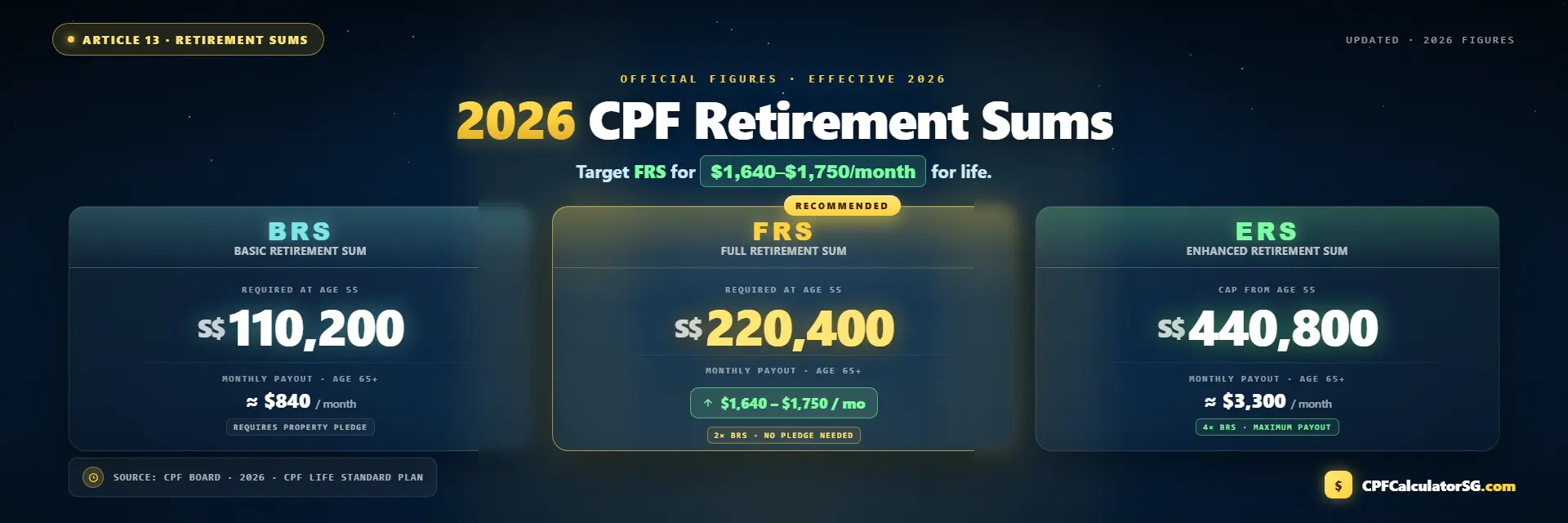
• The 2026 figures are: BRS $110,200 | FRS $220,400 | ERS $440,800 — these apply only to members turning 55 in 2026
• These sums replaced the old "Minimum Sum" from 2016 — same concept, clearer three-tier structure
• The FRS increases by roughly 3–3.5% per year; your cohort's FRS is locked on your 55th birthday and never changes
• CPF LIFE from 65, Standard Plan: about $950 a month at the BRS, $1,780 at the FRS and $3,440 at the ERS
• Falling short of FRS at 55 is not a penalty — you simply receive a lower monthly payout
• Topping up SA to FRS before your 55th birthday locks in years of compounding at 4% p.a. — the window closes permanently at 55
Open any CPF policy document from before 2016 and you will see a number called the "Minimum Sum." CPF Board renamed it the retirement sum in 2016, and the framework today has three levels: the Basic Retirement Sum (BRS), Full Retirement Sum (FRS), and Enhanced Retirement Sum (ERS).
The concept is identical — a target balance for your Retirement Account at 55 — but the three-tier structure makes the trade-offs visible in a way the old single number never did. This guide covers what each level is, the 2026 figures, and how the sums change from year to year.
Why the Old "Minimum Sum" Became BRS/FRS/ERS
Before 2016, CPF members were told to hit a single Minimum Sum by 55. It was a binary pass/fail: you either met it, or you didn't. The problem was that a single number obscured real choices. Members who owned property had different needs from renters. Those who wanted higher retirement income had no formal target beyond the minimum.
The current framework acknowledges three distinct retirement positions:
- BRS (Basic Retirement Sum): For members who own a property with a remaining lease that lasts until at least age 95. They pledge the property to CPF as partial security, allowing them to set aside a lower cash amount in their RA.
- FRS (Full Retirement Sum): The standard target — full cash in the RA, no property pledge required.
- ERS (Enhanced Retirement Sum): For members who want higher CPF LIFE payouts and are willing to put more into the annuity. Increased to 4× BRS (from 3× BRS) in 2025, giving retirees a meaningful step up in monthly income.
The old Minimum Sum was effectively what FRS is today.
The 2026 Figures
| Retirement Sum Level | 2026 Amount | Basis |
|---|---|---|
| Basic Retirement Sum (BRS) | $110,200 | Requires property pledge |
| Full Retirement Sum (FRS) | $220,400 | Standard — 2× BRS |
| Enhanced Retirement Sum (ERS) | $440,800 | Maximum — 4× BRS |
Source: CPF Board, cpf.gov.sg. Figures effective 1 January 2026. Apply to members turning 55 in 2026.
Why the Retirement Sums Rise Each Year
CPF Board says the BRS and FRS are adjusted each year to allow for long-term inflation, longer life expectancy and improvements in the standard of living:
- Cost of living: the BRS is based on the expenditure of a lower-middle retiree household in the latest Household Expenditure Survey, so it moves with updated cost-of-living data.
- The FRS follows the BRS: the FRS is set at twice the BRS. From 2021 to 2027 it rose between 3.2% and 3.5% a year.
Retirement Sums by Year of 55th Birthday
In one line: the Full Retirement Sum is $228,200 for members turning 55 in 2027 and $186,000 for those who turned 55 in 2021 — it has risen about 3.5% a year, and the figure that applied in your own 55th-birthday year is the one that stays with you for life.
| Turning 55 in… | Basic Retirement Sum (BRS) | Full Retirement Sum (FRS) | Enhanced Retirement Sum (ERS) in force that year |
|---|---|---|---|
| 2021 | $93,000 | $186,000 | $279,000 (3× BRS) |
| 2022 | $96,000 | $192,000 | $288,000 (3× BRS) |
| 2023 | $99,400 | $198,800 | $298,200 (3× BRS) |
| 2024 | $102,900 | $205,800 | $308,700 (3× BRS) |
| 2025 | $106,500 | $213,000 | $426,000 (4× BRS) |
| 2026 | $110,200 | $220,400 | $440,800 (4× BRS) |
| 2027 | $114,100 | $228,200 | $456,400 (4× BRS) |
Your BRS and FRS are fixed at the figures for the year you turned 55 and never change again. The ERS is different: CPF Board states it “is not dependent on your age or the year you turn 55 years old. It increases yearly on 1 January.” Read that last column down as a timeline of the top-up ceiling that applied in each year to every member aged 55 and above — not across as your cohort’s own number. The ceiling moved from 3× the BRS to 4× on 1 January 2025, which is why the 2025 row jumps. BRS figures are transcribed from CPF Board; FRS is twice the BRS and ERS is the year’s multiple of it, both derived at build time rather than typed.
The key point: If you turned 55 in 2024, your FRS is $205,800 — not the $220,400 figure for 2026. The current year's FRS only applies to people turning 55 this year.
If you are looking for the figure for a cohort other than 2026, the CPF retirement sum reference lists every year from 2017 onwards in one table.
What Each Level Means at Age 55
BRS with Property Pledge ($110,200)
Monthly CPF LIFE payout at BRS level: about $950 a month under the Standard Plan from age 65, for a member who sets aside the $110,200 BRS at 55 in 2026.
FRS in Cash ($220,400)
Monthly CPF LIFE payout at FRS level: about $1,780 a month under the Standard Plan from age 65, for a member who sets aside the $220,400 FRS at 55 in 2026.
ERS ($440,800)
Monthly CPF LIFE payout at ERS level: about $3,440 a month under the Standard Plan from age 65, for a member who sets aside the $440,800 ERS at 55 in 2026.
| Retirement level | Set aside at 55 | CPF LIFE payout from 65 |
|---|---|---|
| Basic Retirement Sum (with a property pledge) | $110,200 | $950 a month |
| Full Retirement Sum (cash) | $220,400 | $1,780 a month |
| Enhanced Retirement Sum | $440,800 | $3,440 a month |
How this was computed: CPF Board’s own estimates — CPF LIFE Standard Plan, 4% interest, payouts from age 65, for members turning 55 in 2026. Actual payouts depend on the plan chosen, the age payouts start and the balance at that point, so treat these as the published benchmark for this cohort rather than a promise.
Worked Example: Closing the Gap to the Full Retirement Sum
The short answer: Someone at 45 with $120,000 needs about $3,426 a year in cash top-ups to reach the 2026 Full Retirement Sum of $220,400 by 55 — interest does most of the work.
| Step | Working | Figure |
|---|---|---|
| Retirement savings today (age 45) | Special Account plus Ordinary Account | $120,000 |
| The Full Retirement Sum for 2026 | CPF Board, for members turning 55 this year | $220,400 |
| Balance at 55 with no further top-ups | $120,000 at 4% for 10 years | $177,629.31 |
| Shortfall against the Full Retirement Sum | $220,400 − $177,629.31 | $42,770.69 |
| Yearly top-up that closes it | Paid each January, earning 4% until 55 | $3,426 |
| Check | $120,000 plus $3,426 a year for 10 years at 4% | $220,407.55 — just clears it |
| Tax relief that top-up attracts | Capped at $8,000 a year for your own account | Fully within the cap |
How this was computed: Interest is the Special Account floor rate of 4%, held flat and compounded yearly, with CPF’s extra interest ignored. The Full Retirement Sum rises each year, so someone turning 55 later faces a higher target than $220,400; treat this as the method, not a forecast.
What Happens If You Fall Short at 55
There is no fine or penalty for not reaching BRS or FRS at 55. The consequence is straightforward: your RA balance determines your CPF LIFE payout, and a lower balance means a lower monthly income.
If your RA is below BRS at 55, CPF Board will write to explain your options:
- Continue as-is — receive a smaller CPF LIFE payout from 65
- Make voluntary cash top-ups to your RA after 55 to increase the balance (top-ups after 55 go to RA, not SA — SA closes as a contribution destination on your 55th birthday)
- Consider the property pledge if you own property — to potentially meet BRS with a lower cash balance
The pre-55 window matters for this reason. Every voluntary SA top-up made before your 55th birthday contributes to your eventual RA balance. After 55, the SA closes — top-ups go to RA, but the compounding years in SA are gone.
SA Top-Ups Before 55
A cash top-up to your Special Account can be made until you turn 55, and the balance counts toward the Retirement Account set aside at 55. The terms are:
- The SA earns 4% a year (CPF Board rate, as at 20 August 2026)
- A $10,000 top-up at age 45 grows to about $14,802 by 55 at 4% a year, compounded annually and ignoring extra interest, which is 48% more
- Cash top-ups to your own SA qualify for tax relief of up to $8,000 a year under the RSTU scheme
- Cash top-ups to the SA stop at 55; after that they go to the RA
The CPF Calculator projects how SA top-ups grow toward the FRS. This is general information, not financial advice.
Use the CPF Calculator →Common Confusion: "My FRS Has Changed"
Members sometimes see a different FRS on their CPF statement than expected. This happens because:
- Your cohort's FRS is locked at 55. The figure that applied when you turned 55 stays with you permanently.
- The annual increase only applies to new cohorts. The rise of about 3.5% each year sets the FRS for the next group turning 55. It does not retroactively raise the bar for people who already turned 55.
- ERS can still be topped up after 55. Even after your FRS is locked, you can top up your RA above FRS — up to the ERS in force this year, which rises every 1 January for every member aged 55 and above — to get higher CPF LIFE payouts.
2026 CPF Retirement Blueprint (PDF)
BRS, FRS and ERS explained — with payout tables, cohort comparisons, and a top-up action plan. Free download.
Video: BRS, FRS and ERS Explained
Frequently Asked Questions
My CPF dashboard shows an "FRS shortfall." Do I have to pay something?
No. It is informational — showing the gap between your current RA balance and your cohort's FRS. You can choose to top up the gap, or accept that your CPF LIFE payout will reflect your actual balance. There is no penalty.
Can I take a lump sum withdrawal at 55 if I meet FRS?
Yes. If your CPF balance at 55 exceeds your applicable FRS, the excess is available for withdrawal. You do not have to withdraw — the money can stay in OA earning 2.5%.
Does the property pledge mean CPF takes my flat?
No. A property pledge means that if you sell the property, the proceeds are used to top up your RA up to the FRS before you receive the rest. It is not a mortgage or lien — it does not affect your use of the property.
I am 50 now. Does it matter whether I top up to the FRS this year or later?
CPF credits interest yearly, so a top-up made earlier earns interest for more years: at 4% a year, $10,000 becomes about $12,167 in five years (age 50 to 55) and about $14,802 in ten. Whether to top up depends on your cash needs and other goals; this is not financial advice.
What is the difference between Standard Plan and Basic Plan CPF LIFE?
Standard Plan provides higher monthly payouts but a smaller bequest (residual balance passed to nominees on death). Basic Plan provides slightly lower monthly payouts but preserves more residual value for nominees. Most members — especially those without dependants — choose Standard.
Can I top up to ERS after turning 55?
Yes. You can top up your RA above FRS up to the Enhanced Retirement Sum even after 55. Unlike your BRS and FRS, the ERS is not locked to your cohort — CPF Board raises it every 1 January, so the ceiling rises each year for every member aged 55 and above. These top-ups also qualify for tax relief.
Written by the team at CPF Calculator SG. Reviewed against CPF Board policies effective January 2026. Retirement sum figures from CPF Board, cpf.gov.sg. CPF LIFE payout estimates are indicative ranges; actual payouts depend on plan choice, prevailing interest rates, and individual balances. For the authoritative source, visit cpf.gov.sg. This article is for general information only and does not constitute financial advice.