Last reviewed: 20 August 2026 | Next review: January 2027 | Reading time: 9 min
Key Takeaways
- New PRs start at reduced CPF rates: Year 1 = 9% total (5% EE + 4% ER)
- Year 2 = 24% total (15% EE + 9% ER). Year 3+ = full citizen rates
- Year 1 begins from the month PR status was granted — not your employment start date
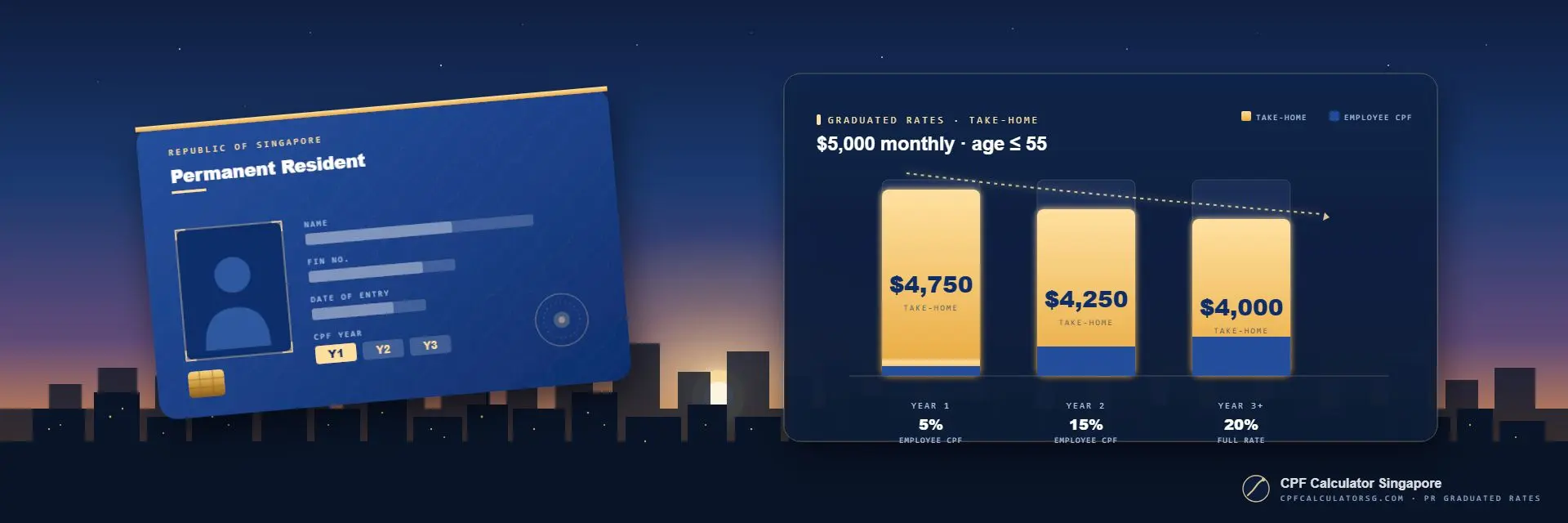
- By Year 3 your take-home is $750 a month lower than in Year 1, at a $5,000 salary. The Year 2 to Year 3 step is $250 of that.
- Employer and employee can jointly apply to CPF Board to pay higher rates from Day 1: full rates on both sides, or a full employer rate with the graduated employee rate
When you become a PR, your payslip shows lower CPF deductions and more take-home pay. The rates then rise in Year 2 and again in Year 3, so take-home falls twice. This guide sets out the rates and what each step does to a $5,000 salary.
Why Graduated Rates Exist
When you become a Singapore Permanent Resident, CPF Board doesn't immediately apply full citizen rates. For the first two years both you and your employer contribute at graduated rates, which CPF Board says helps a new PR adjust to the lower take-home pay that full contributions bring. From Year 3 you are on the same rates as Singapore Citizens of the same age.
This guide walks through the graduated rates at 55 and below. For the rate at every PR year and every age band, including the F/G tables, see the CPF contribution rates for PRs reference.
The Three-Year Rate Table
Effective 1 January 2026. For employees below age 55.
| Year | Employee Rate | Employer Rate | Total | Take-home on $5,000 |
|---|---|---|---|---|
| Year 1 (SPR) | 5% | 4% | 9% | $4,750 |
| Year 2 (SPR) | 15% | 9% | 24% | $4,250 |
| Year 3+ (full) | 20% | 17% | 37% | $4,000 |
Source: CPF Board. Rates apply to Singapore PRs (SPR) below age 55 with monthly wages above $750.
The pattern is the same for other age groups: Year 1 is the most reduced, Year 2 intermediate, Year 3+ equals the full citizen rate for that age bracket.
The Year 1 to Year 3 shift at a glance:
| PR Year 1 | Citizen (Year 3+) | |
|---|---|---|
| Salary | $5,000 | $5,000 |
| Employee CPF | $250 (5%) | $1,000 (20%) |
| Employer CPF | $200 (4%) | $850 (17%) |
| Take-home | $4,750 | $4,000 |
| Employer monthly cost | $5,200 | $5,850 |
Take-home pay is $750 a month lower in Year 3 than in Year 1 at a $5,000 salary. It is not a pay cut: the same salary carries a higher CPF contribution.
Calculate your exact CPF contributions based on your salary, age and citizenship status.
Open the Free CPF Calculator →How Year 1 Is Counted
Year 1 begins from the month your PR status was granted — not your employment start date.
If you've been working in Singapore on an Employment Pass for three years, then convert to PR in October 2026, your CPF Year 1 begins in October 2026. You get no credit for the prior years on EP.
The reference date is the one on your Entry Permit (the formal letter from ICA), not when you collected your IC, not when you told HR.
The start date decides when Year 2 and Year 3 rates begin, so it affects your contributions and your employer’s payroll calculations.
OA / SA / MA Allocation in Each Year
Your CPF contributions are split across accounts regardless of which year you're in — the split just reflects the smaller total amounts in Years 1 and 2.
For PRs below 35, the allocation ratios are the same as citizens:
| Account | Ratio of total contribution |
|---|---|
| OA | 62.2% |
| SA | 16.2% |
| MA | 21.6% |
In practice, for Raj ($5,000 salary):
| Year 1 ($450 total CPF) | Year 3 ($1,850 total CPF) | |
|---|---|---|
| OA | ~$280 | ~$1,150 |
| SA | ~$73 | ~$300 |
| MA | ~$97 | ~$400 |
The OA receives $280/month in Year 1 against $1,150 from Year 3, about $10,400 a year more, which matters if you plan to use OA for an HDB purchase.
Model your CPF growth across all three PR years → cpfcalculatorsg.com/calculator.html
The Joint Application for Higher Rates
A new PR and their employer can jointly apply to CPF Board to contribute at higher rates in the first two years of PR status. CPF Board offers two options: both sides contribute at full rates, or the employer contributes at the full rate while the employee stays on graduated rates. The employer submits the application together with the employee, and CPF Board says it processes it within seven working days of receiving the necessary information. The table shows Raj on each option.
| Option | Year 1 rates (employee / employer) | Year 2 rates | Year 1 take-home | Year 2 take-home | Year 1 employer cost | Year 2 employer cost |
|---|---|---|---|---|---|---|
| Default: graduated employer, graduated employee | 5% / 4% | 15% / 9% | $4,750 | $4,250 | $5,200 | $5,450 |
| Full employer, graduated employee | 5% / 17% | 15% / 17% | $4,750 | $4,250 | $5,850 | $5,850 |
| Full employer, full employee | 20% / 17% | 20% / 17% | $4,000 | $4,000 | $5,850 | $5,850 |
Situations where the higher rates may be relevant:
- Someone planning an HDB purchase soon who wants OA to build faster
- A company founder or director who wants more CPF retirement savings from Day 1
- An employer that already pays all other employees at full rates and wants payroll simplicity
- Someone who wants the 4% SA rate applied to larger contributions from the start
What changes under each option: take-home pay falls under the full employer, full employee option, because the employee share rises from 5% to 20% in Year 1. Under the full employer, graduated employee option the employee share is unchanged and the employer’s cost rises from 4% to 17% of wages in Year 1.
Raj's First Three Years — Full Dollar Walkthrough
Raj is 28, just received PR, earning $5,000/month.
Year 1 (from the PR date to the end of the first anniversary month):
| Amount | |
|---|---|
| Employee CPF (5%) | $250 |
| Employer CPF (4%) | $200 |
| Total CPF | $450 |
| Raj's take-home | $4,750 |
Raj's employer's monthly cost: $5,200.
Year 2 (from the month after the first anniversary):
| Amount | |
|---|---|
| Employee CPF (15%) | $750 |
| Employer CPF (9%) | $450 |
| Total CPF | $1,200 |
| Raj's take-home | $4,250 |
Take-home falls by $500/month from Year 1 to Year 2, the first step down.
Year 3+ (from the month after the second anniversary):
| Amount | |
|---|---|
| Employee CPF (20%) | $1,000 |
| Employer CPF (17%) | $850 |
| Total CPF | $1,850 |
| Raj's take-home | $4,000 |
The Year 2 to Year 3 step is smaller than the first: take-home falls another $250/month.
Over three years, Raj's take-home drops $750/month at the same salary. It is not a pay cut: the same salary carries a higher CPF contribution, which is credited to his own OA, SA and MA.
Set two calendar reminders: one before your first PR anniversary (Year 2 rates start the month after it) and one before your second (full rates start the month after it). Adjust your budget before each, not after.
What If You're an Older New PR?
Raj is 28. Plenty of people receive PR in their 40s or 50s.
If you receive PR at age 52, you enter the graduated system in the 50–55 age bracket. Your Year 1 and Year 2 rates are the reduced graduated rates for that age bracket — then at Year 3 you step up to full 50–55 citizen rates.
Age milestones (55, 60, 65) interact independently with your PR year count. If you receive PR at 54 and turn 55 in Year 2, the 55+ age bracket rules apply from the month after your birthday month, overlaid on whichever PR year you're in.
For the full picture of what changes at 55 for everyone, see How CPF Contributions Change at Age 55, 60 and 65.
What Happens When You Become a Citizen?
If you convert from PR to Singapore Citizen, you immediately move to full citizen rates — no waiting for Year 3.
Your CPF accounts continue without interruption. No reset, no new account structure. The day your citizenship is confirmed, you're on the standard rate for your age group.
Does Your PR Year Reset If You Change Jobs?
No. The PR year count is tied to your PR status date, not your employer.
However: your new employer is responsible for applying the correct rates. When you onboard, confirm your PR grant date with them explicitly. If they default to Year 1 when you're actually in Year 3, you're underpaying CPF — which directly reduces your OA, SA, and MA accumulation.
Check your CPF contribution history quarterly via my.cpf.gov.sg to catch any errors early.
Does Your Partner's PR Status Affect Yours?
No. Each individual's PR year count is independently tracked. If you and your spouse received PR at different times, you may be in different CPF years simultaneously — no cross-calculation, no averaging.
Planning for the Year 3 Take-Home Drop
At $8,000 salary — exactly at the Ordinary Wage ceiling that applies from 1 January 2026, so the full salary is CPF-applicable:
| Year 1 | Year 2 | Year 3 | |
|---|---|---|---|
| Employee CPF | $400 (5%) | $1,200 (15%) | $1,600 (20%) |
| Take-home | $7,600 | $6,800 | $6,400 |
From Year 1 to Year 3, take-home drops by $1,200/month on an $8,000 salary. That is $1,200 a month less in hand, so plan for it before Year 2 and again before Year 3.
Three-step plan:
1. Six months before Year 2: review all recurring expenses, identify what to trim if needed
2. Six months before Year 3: same exercise again — the second jump is smaller but still meaningful
3. From the month after your second anniversary: you contribute at full rates. Cash top-ups to the SA and RA qualify for tax relief up to a cap, if they suit your circumstances
See your exact take-home in each PR year → cpfcalculatorsg.com/calculator.html
The CPF Benefits You're Now Part Of
The graduated rates are a temporary transition. Once you're at Year 3, you're in the full CPF system:
- OA for housing: Downpayments, monthly mortgage repayments on eligible HDB and private properties
- MediSave: Hospitalisation, approved outpatient treatments, MediShield Life premiums
- SA/RA interest: 4% a year (CPF Board rate, as at 20 August 2026), building toward CPF LIFE retirement payouts from age 65
- Tax relief: Cash top-ups to SA and RA qualify for RSTU tax relief up to $8,000/year
- CPFIS: Investment of OA balances above $20,000 in approved instruments
Frequently Asked Questions
What are the CPF contribution rates for a PR in Year 1 and Year 2 in 2026?
Under the standard graduated scheme and aged 55 or below, Year 1 is 5% employee and 4% employer, 9% in total. Year 2 is 15% employee and 9% employer, 24% in total. Full citizen rates of 20% and 17% apply from Year 3.
When does Year 1 start exactly — the day ICA grants PR, or the month?
Year 1 begins from the month your PR status was granted. If your Entry Permit is dated 15 October 2026, Year 1 runs from that date to 31 October 2027, the end of the month of your first anniversary, and Year 2 begins in November 2027. Year 3 begins in the month after your second anniversary.
My employer is applying Year 1 rates but I am in Year 2. What do I do?
Check your contribution history at my.cpf.gov.sg. If the rates are wrong, contact HR with your Entry Permit date — employers can correct historical underpayments, and CPF Board can be approached for employer compliance issues.
Can I pay full citizen rates if my employer will not agree to a joint application?
A joint application needs both parties. Without employer agreement you stay on the graduated rates for the mandatory portion. Note what the application changes: the full employer / graduated employee option pays 17% employer in Year 1 instead of 4%, while your own share stays at 5%. You can always make voluntary top-ups independently.
Do graduated rates apply to every age group, including 55 and above?
Yes — every age band has its own Year 1 and Year 2 rates. A new PR aged above 55 to 60 pays 9% in total in Year 1 and 18.5% in Year 2, against the 34% a citizen in the same band pays.
If I switch from an Employment Pass to PR, do my EP years count toward CPF?
No. Employment Pass holders do not contribute to CPF. Your CPF history starts from your PR grant date and there are no retrospective credits.
What happens if I leave Singapore and my PR lapses?
If PR is cancelled you can apply to withdraw your CPF balance under CPF Board’s overseas withdrawal scheme, subject to the conditions in force at the time.
Is the MediSave requirement different for PRs and citizens?
No. MediSave contributions and the Basic Healthcare Sum — $79,000 in 2026 — work identically for PRs and citizens. Only the contribution rate is graduated, not the allocation rules.
I became a PR at 54. What happens when I turn 55 in Year 2?
The standard age-milestone changes apply: your Retirement Account is created, your Special Account balance is swept into it up to the Full Retirement Sum of $220,400, and your contribution band changes. The PR-year count and the age milestone run in parallel — neither overrides the other.
Can my employer keep me on Year 1 rates and refuse to apply Year 2?
No. The graduated rates are legally mandated. Year 2 begins automatically in the month after your first PR anniversary, and failing to apply the correct rates is an employer compliance violation.
Is the Ordinary Wage ceiling of $8,000 the same for PRs?
Yes. The Ordinary Wage ceiling of $8,000 a month and the $102,000 annual salary ceiling apply equally to citizens and PRs, in every PR year and at every age.
Your PR CPF Checklist
- [ ] Note your Entry Permit date — this is Day 1 of Year 1
- [ ] Confirm HR has the correct date on file
- [ ] Set a calendar alert before your first PR anniversary (Year 2 starts the month after; take-home drops ~$500 on a $5,000 salary)
- [ ] Set a calendar alert before your second PR anniversary (Year 3 starts the month after; take-home drops another ~$250)
- [ ] If buying HDB soon, ask your employer about the joint application for higher rates
- [ ] Once on full rates, review whether SA cash top-ups, which qualify for tax relief up to a cap, suit you
- [ ] Check CPF contribution history quarterly at my.cpf.gov.sg
Know someone who has just become a PR? Share this with them.
Written by the team at CPF Calculator SG. CPF graduated rates sourced from CPF Board. For the authoritative source, visit cpf.gov.sg. This article is for general information only and does not constitute financial advice. Next review: January 2027.