Last reviewed: 20 August 2026 | Next review: January 2027 | Reading time: 12 min
Key Takeaways
- CPF contribution rates for workers aged 55–65 increased on 1 January 2026, by 1.5 percentage points in each band
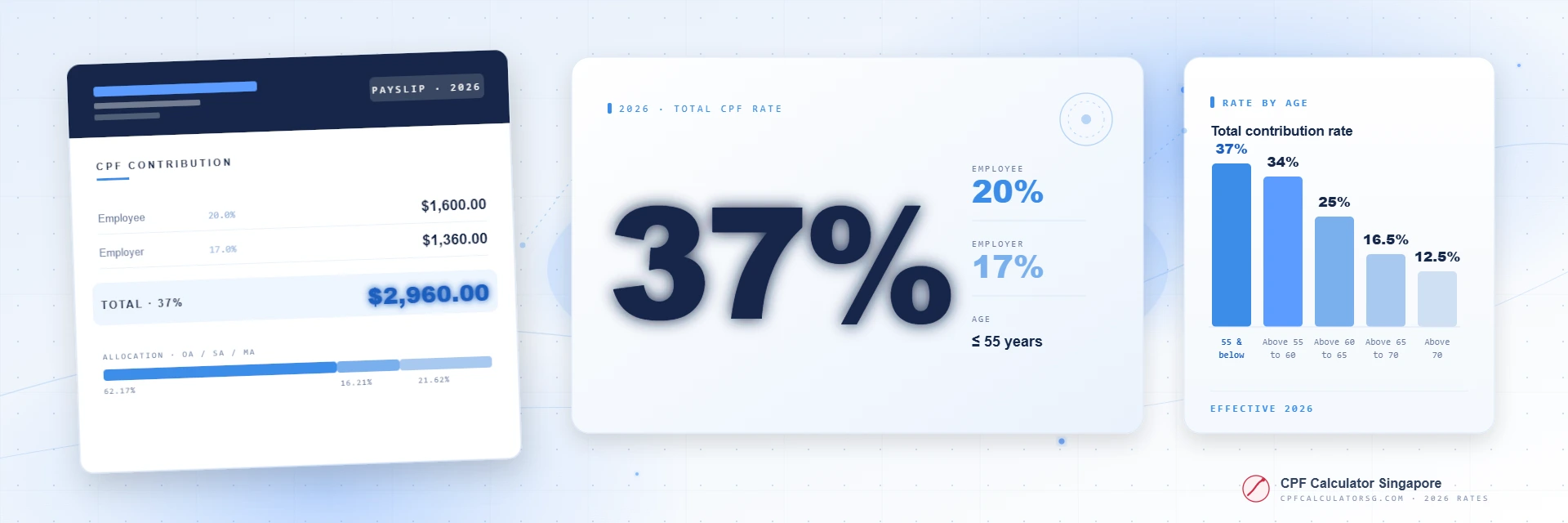
- The under-55 rate stays at 37% total (20% employee + 17% employer)
- Workers aged 55–60 are now at 34% total (up from 32.5% in 2025); aged 60–65 at 25% total (up from 23.5%) — both +1.5 percentage points
- Contributions are capped at the $8,000/month Ordinary Wage ceiling (raised from $7,400 in Jan 2026)
- Use the CPF Calculator to get your exact numbers
CPF contribution rates for workers aged above 55 to 65 rose on 1 January 2026, so a January payslip can differ from the one before. This guide covers every age bracket, the 2026 allocations, and three worked examples.
Why CPF Rates Are Different by Age
CPF contributions are mandatory savings split between you and your employer. The total rate, and where it goes, changes with your age:
- Younger workers get more going into their Ordinary Account (OA) for housing and investments
- Older workers see rates step down as they approach retirement, keeping more cash in hand
- Post-55 workers see contributions redirected toward the Retirement Account (RA) rather than SA
Understanding which bracket you're in is the starting point for everything else.
2026 CPF Contribution Rates by Age (5 Brackets)
Effective 1 January 2026. Applies to Singapore Citizens and PRs from Year 3 onwards with monthly wages above $750.
| Age (last birthday) | Employee | Employer | Total |
|---|---|---|---|
| 55 and below | 20% | 17% | 37% |
| Above 55 to 60 | 18% | 16% | 34% |
| Above 60 to 65 | 12.5% | 12.5% | 25% |
| Above 65 to 70 | 7.5% | 9% | 16.5% |
| Above 70 | 5% | 7.5% | 12.5% |
Source: CPF Board, cpf.gov.sg — CPF Contribution Rates from 1 January 2026.
What Changed in January 2026
The under-55 rates held steady at 37%. The increases were targeted at workers aged 55–65:
| Age Group | Previous Total | 2026 Total | Change |
|---|---|---|---|
| Above 55 to 60 | 32.5% | 34% | +1.5 percentage points |
| Above 60 to 65 | 23.5% | 25% | +1.5 percentage points |
| Above 65 to 70 | No change | 16.5% | — |
| Above 70 | No change | 12.5% | — |
CPF Board allocates the whole 2026 increase to the Retirement Account, up to the Full Retirement Sum; a member who has already set aside the FRS has it channelled to the Ordinary Account instead. The 2026 rates are not the last step: from 1 January 2027 the total rate rises to 35.5% for ages above 55 to 60 and 26% for above 60 to 65 (see CPF contribution rates 2027).
Calculate your exact CPF contributions based on your salary, age and citizenship status.
Open the Free CPF Calculator →The Ordinary Wage Ceiling
CPF contributions only apply to Ordinary Wages up to the OW ceiling of $8,000/month (raised from $7,400 on 1 January 2026).
Every dollar above $8,000 is CPF-free — for both you and your employer.
What this means if you earn $10,000:
- CPF is calculated on $8,000, not $10,000
- The remaining $2,000 goes straight to take-home pay
- Your employer also only pays CPF on $8,000
There's a separate Annual Wage ceiling of $102,000 for bonuses and variable pay (Additional Wages). If you've already hit $96,000 in ordinary wages in a year ($8,000 × 12), Additional Wage CPF may be reduced. Your payroll software handles this automatically, but it's worth knowing if you receive large bonuses.
If you know your age but not your band, the CPF contribution rate by age reference resolves one into the other, one row per age.
Where Does the Money Actually Go? OA / SA / MA Allocations
Contributing 37% (or 34%, or 25%) is the starting point. What matters is which account receives each dollar.
Effective 1 January 2026. Figures are % of your total monthly salary.
| Age | OA | SA / RA | MA | Total |
|---|---|---|---|---|
| 35 and below | 23% | 6% (SA) | 8% | 37% |
| 36 to 45 | 21% | 7% (SA) | 9% | 37% |
| 46 to 50 | 19% | 8% (SA) | 10% | 37% |
| 51 to 55 | 15% | 11.5% (SA) | 10.5% | 37% |
| 56 to 60 | 12% | 11.5% (RA) | 10.5% | 34% |
| 61 to 65 | 3.5% | 11% (RA) | 10.5% | 25% |
| 66 to 70 | 1% | 5% (RA) | 10.5% | 16.5% |
| 71 and above | 1% | 1% (RA) | 10.5% | 12.5% |
Note: "SA" applies up to age 55. Above 55, contributions go to the Retirement Account (RA) instead: the SA closes as a contribution destination after your 55th birthday.
The pattern: the MA share is 10% of salary above age 45 to 50 and 10.5% from above 50 onwards. The OA share falls to 3.5% above 60 to 65 and to 1% above 65.
Three Worked Scenarios
James, 35, Singapore Citizen, $6,000 salary
James earns below the OW ceiling, so his full salary is CPF-applicable.
| Amount | |
|---|---|
| Employee CPF (20%) | $1,200 |
| Employer CPF (17%) | $1,020 |
| Total CPF | $2,220 |
| Take-home | $4,800 |
Where his $2,220 goes:
- OA: $1,380 (23% of salary — goes toward future housing, investments)
- SA: $360 (6% — earns 4%, building his retirement base)
- MA: $480 (8% — medical coverage)
James is in the sweet spot: high employer contributions, healthy OA accumulation, SA compounding for retirement. Every year from now to 55 is building the base that funds his CPF LIFE payouts.
Mei Lin, 57, Singapore Citizen, $6,500 salary
Mei Lin falls in the 55–60 bracket. Her $6,500 salary is below the OW ceiling, so full rates apply.
| Mei Lin at 57 (55–60 rates) | Equivalent salary under 55 | |
|---|---|---|
| Employee CPF | 18% × $6,500 = $1,170 | 20% × $6,500 = $1,300 |
| Employer CPF | 16% × $6,500 = $1,040 | 17% × $6,500 = $1,105 |
| Take-home | $5,330 | $5,200 |
The drop in contribution rate means Mei Lin takes home $130 more per month than she would at the same salary under age 55. That's $1,560/year in her pocket — a quiet raise she didn't have to negotiate.
Her contributions now flow to OA ($780/month = 12%), RA ($747/month = 11.5%), and MA ($682/month = 10.5%) rather than SA.
Uncle Lim, self-employed, $80,000 Net Trade Income
Uncle Lim has no employer, so no mandatory OA or SA contributions. But MediSave is compulsory.
At $80,000 NTI and age 40:
- Mandatory MediSave contribution: $7,200/year (9% of NTI for his age band, below its $8,640 annual maximum)
Uncle Lim can also make voluntary cash top-ups to his SA each year. The SA earns 4% a year (CPF Board rate), and a cash top-up to his own SA qualifies for tax relief up to an annual cap. The full breakdown is in CPF for Self-Employed Singaporeans: MediSave, Voluntary Top-Ups and Tax Relief.
The Logic Behind the Rate Increases
The 2026 increase for workers aged above 55 to 65 is 1.5 percentage points in each band, and a further increase takes effect on 1 January 2027.
The problem being solved: workers who turned 55 a decade ago spent much of their career at significantly lower CPF rates. That meant a smaller RA at 55, and lower CPF LIFE payouts at 65. By pushing rates higher in the final working years, the government gives the system a chance to partly compensate for that structural gap.
The design is also employer-conscious. Rather than a single sharp increase, the phased approach gave businesses time to absorb the higher employment cost for older workers — reducing the incentive to favour younger hires on cost alone.
New Permanent Residents are on graduated rates for their first two years, not the rates above. The CPF contribution rates for PRs reference has every PR year and age band in one table.
Employers owe only their own share of the figures above, capped by the wage ceilings. The employer CPF contribution rates page has the employer column for 2026 and 2027 and the maximum cost per employee.
Special Cases Worth Knowing
Permanent Residents
PRs don't start at full citizen rates. There's a graduated structure for the first two years:
- Year 1: 5% employee + 4% employer (total 9%)
- Year 2: 15% employee + 9% employer (total 24%)
- Year 3+: Full citizen rates (same as the table above)
Full details and dollar examples in CPF for Permanent Residents: The Complete Guide to Years 1, 2 and 3.
Part-Month Employment
CPF is calculated on the actual wages paid in the calendar month — not a full month's salary. Join on the 20th and only worked 10 days? CPF applies to what you were paid for those days.
Wages Below $750/Month
No CPF is payable on total monthly wages of $50 or less. Above $50 up to $500 only the employer’s share is payable. Above $500 up to $750 the employee’s share is phased in as well. Full-time workers don't typically encounter this, but it matters for casual and part-time arrangements.
Planning Implications: What the 2026 Rates Mean for You
If you're approaching 55: A cash top-up to the SA can only be made before your 55th birthday, because the SA closes at 55. Whether a top-up suits you depends on your circumstances. How CPF Contributions Change at Age 55, 60 and 65 sets out what changes.
If you're 55–65 now: CPF Board allocates the 2026 increase to your RA up to the Full Retirement Sum, and the RA earns 4% a year. Your projected CPF LIFE payout is shown at my.cpf.gov.sg.
If you're an employer with workers aged 55–65: The employer’s share for this group rose from 15.5% to 16%. At $6,500/month for a 57-year-old, employer CPF was $1,007.50 in 2025 and is $1,040 in 2026, which is $32.50 a month more per employee.
If you're thinking about OA–SA strategy: The OA pays 2.5% a year and the SA 4%. Over 20 years with no withdrawals and no extra interest, $10,000 grows to about $16,386 at 2.5% and about $21,911 at 4%; this is an illustration, not a forecast. Full analysis in CPF OA vs SA Transfer: Should You Move Your Money?
A Calculation Error to Check For
CPF calculated on the full salary of an employee who earns above the Ordinary Wage ceiling is an error. Ordinary Wages attract CPF only up to $8,000/month (from 1 Jan 2026).
If you earn $10,000 a month in Ordinary Wages and your payslip shows CPF calculated on $10,000, the base is wrong, because the ceiling is $8,000. Ask your payroll team to check it.
The reverse is also worth checking: if your payslip shows a lower CPF base than your actual salary below $8,000, that is an under-contribution, which affects your OA, SA and MA balances directly.
Use the Calculator to Get Your Number
Rates and allocations are one thing. Your specific take-home and CPF split depends on your salary, age, and residency status.
If you're planning to buy an HDB flat, your take-home pay and OA balance together determine what flat price is in reach. See what your income unlocks with the HDB Affordability Calculator.
Run your numbers → CPF Contribution Calculator
Input your details and the calculator handles the age-bracket logic, OW ceiling cap, and allocation split.
Frequently Asked Questions
Will my take-home pay fall because of the 2026 rate changes?
Only if you are above 55. Below 55 nothing changed: still 20% employee and 17% employer, 37% in total. Above 55 to 60 the total rate rose from 32.5% in 2025 to 34% in 2026, with the employee share going from 17% to 18%. Above 60 to 65 the total rose from 23.5% to 25%, with the employee share going from 11.5% to 12.5% — slightly less cash now, more going into your own accounts.
Does the new rate apply from my birthday, or the month after?
The month after your birthday month. If you turn 55 in June, July’s payroll is the first month on the above-55-to-60 rates.
My employer says CPF does not apply to my bonus. Is that right?
Only partly. A bonus is an Additional Wage, and CPF is payable on it up to the annual salary ceiling of $102,000 across all wages for the year. Once your ordinary wages have used $96,000 of that — $8,000 a month for 12 months — the CPF payable on the bonus is reduced accordingly.
I am a Singapore PR — am I on the same rates as citizens in 2026?
Not for your first two years. Under the graduated scheme and aged 55 or below, Year 1 is 5% employee plus 4% employer (9%) and Year 2 is 15% plus 9% (24%). Full citizen rates apply from Year 3. See CPF for PRs: the graduated rates explained.
What is the difference between the OA and SA interest rates?
The Ordinary Account pays a floor of 2.5% a year and the Special Account 4%. Below 55 an extra 1% is paid on the first $60,000 of combined balances, of which at most $20,000 may come from the OA. See the OA-to-SA transfer guide.
I earn exactly $8,000 — is my whole salary CPF-applicable?
Yes. The Ordinary Wage ceiling is $8,000 a month, so a salary of exactly $8,000 is fully covered. The cap only bites above that figure.
Can I opt out of CPF?
No. Contributions are legally mandated for Singapore Citizens and PRs in employment, and employers who fail to contribute face penalties. There is no opt-out.
What happens to my CPF if I emigrate permanently?
Citizens and PRs who renounce their status can apply to withdraw their CPF balance once CPF Board’s conditions are met. The application is made through CPF Board directly.
How do I check that my employer is paying the right CPF amount?
Log in to my.cpf.gov.sg with Singpass. Your contribution history is listed by month and by employer, and any discrepancy can be reported to CPF Board’s employer compliance team.
Can I contribute more to CPF than the mandatory amount?
Yes, through voluntary contributions and cash top-ups. Cash top-ups to the Special Account below 55, or the Retirement Account from 55, attract tax relief of up to $8,000 a year for yourself and a further $8,000 for family members under the RSTU scheme.
My payslip shows CPF Employee and CPF Employer separately. Is the employer share really mine?
Yes. Both amounts go into your CPF accounts — none of it stays with your employer. For a member aged 35 and below, the combined 37% of wages is split 23% to the Ordinary Account, 6% to the Special Account and 8% to MediSave.
What is the full 2026 CPF contribution rate table?
55 & below: 20% employee + 17% employer = 37%. Above 55 to 60: 18% + 16% = 34%. Above 60 to 65: 12.5% + 12.5% = 25%. Above 65 to 70: 7.5% + 9% = 16.5%. Above 70: 5% + 7.5% = 12.5%. All figures are of wages up to the $8,000 monthly ceiling.
What to Do Next
- Check your current payslip against the 2026 rate for your age bracket
- Run your exact figures through the CPF Calculator
- If you're within 10 years of 55, read How CPF Changes at 55, 60 and 65 — especially the pre-55 SA top-up window
- If you're holding a large OA balance with no near-term housing plans, read CPF OA vs SA Transfer
Know someone who just received their first Singapore payslip and is staring at the CPF deduction in confusion? Share this with them — it's the one guide that actually explains what's happening.
Written by the team at CPF Calculator SG. Figures based on CPF Board published rates effective 1 January 2026. For the authoritative source, visit cpf.gov.sg. This article is for general information only and does not constitute financial advice. We review all figures annually — next review January 2027.