Key Takeaways
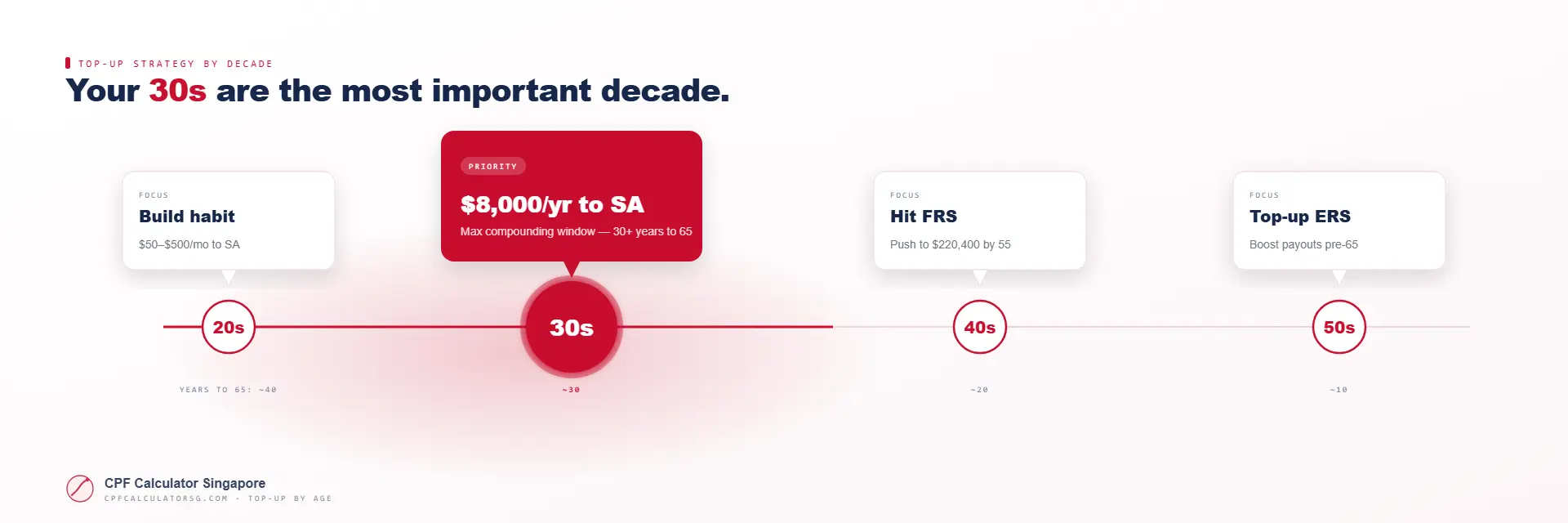
- SA money compounds at 4% until 55 (CPF Board rate, as at 20 August 2026), so the earlier a top-up goes in, the longer it earns; your 30s still leave around 20 years of that runway
- Waiting another decade to put a $50,000 balance into SA cuts its value at 55 by about $36,000 (4% p.a., no other change)
- The full $8,000 a year from 35 rather than from 45 earns about $62,000 more in interest by 55 (4% p.a., each top-up made at year end)
- In your 40s, the full $8,000 annual SA top-up relief is available and there are still 10–15 years before 55 for the money to compound
- In your 50s, the pre-55 window for SA top-ups is closing, and a year of 4% compounding not started cannot be made up later
- The OA-to-SA transfer is irreversible, so weigh it against your housing plans at every age
The Life Timeline
Age 25–35: Foundation Phase
└─ Build OA for housing | Let SA compound quietly | Learn the system

Age 35–45: Growth Phase
└─ SA top-ups can begin | $8,000 tax relief available | Check FRS trajectory

Age 45–55: Acceleration Phase
└─ Full RSTU each year is possible | Check the gap to FRS | Last SA top-ups before 55

Age 55+: Distribution Phase
└─ RA compounds at 4% | Manage CPF LIFE options | Consider deferring payouts
Summary Table: CPF Priorities by Decade
| Age Group | Primary Focus | Why It Matters |
|---|---|---|
| 20s | Understand the system; build OA; let SA compound | Foundation for both housing and retirement |
| 30s | Voluntary SA top-ups can start; check FRS trajectory | Around 20 years of 4% compounding remain before 55 |
| 40s | Full $8,000 SA top-up each year, if affordable; check property position | Higher income for many people, and 10–15 years still to run before 55 |
| 50s | Final SA top-ups before 55; understand RA formation; plan property moves | The window closes at 55; decisions made here are permanent |
In Your 20s: Build the Foundation
Your under-35 CPF allocation puts 23% of your salary into OA — the highest OA allocation of any age group. SA receives 6% and MA receives 8%. Your SA balance is growing quietly at 4% p.a. The compounding clock has started.
What You Can Do
Learn the system first. Understanding the OW ceiling, account allocations, and the purpose of each account is a sound first step.
Buying early has a cost. Using OA for an early flat purchase locks up OA funds and creates an accrued interest obligation. Every year before buying is another year of OA compounding at 2.5% with no accrued interest clock running.
The OA-to-SA transfer suits you only if your housing plans are clear. At 25, the transfer looks mathematically attractive — you move from 2.5% to 4%. But if you need OA for a flat in your late 20s or early 30s, the irreversibility becomes a problem.
In Your 30s: About 20 Years to 55
A worked example shows how much the starting age changes the result.
At 35, your SA has 20 years to compound before you turn 55. At 4% p.a. (the CPF Board SA rate, as at 20 August 2026), $50,000 in SA at age 35 becomes approximately $110,000 by 55 with no additional contributions. The same $50,000 contributed at age 45 grows to only $74,000. The 10-year delay costs about $36,000 on a single $50,000 contribution at these rates, and the years of compounding lost cannot be made up.
A 30s Checkpoint
| SA Balance at 35 | Projected SA at 55 (4% p.a., no top-ups) | Gap to the FRS at 55 (revised each January; $220,400 in 2026) |
|---|---|---|
| $30,000 | ~$66,000 | Large gap: the balance alone falls well short |
| $60,000 | ~$131,000 | Meaningful gap: top-ups would narrow it |
| $100,000 | ~$219,000 | Smaller gap: top-ups would still narrow it |
What You Can Do
- Voluntary SA cash top-ups can start small. Even $2,000–$3,000/year earns the SA rate and counts toward relief. Starting a habit early matters more than starting with the full amount.
- Tax relief applies every year. Every cash top-up to SA (up to $8,000/year) reduces your taxable income.
- Check your FRS trajectory. The FRS for 2026 is $220,400 and is revised every January, so the figure for your own 55th year will differ. CPF Board has published $228,200 for 2027, up 3.5% on 2026; if it kept rising at that pace, it would reach about $371,000 for those turning 55 in 2041. CPF Board does not publish future retirement sums, so read that as an illustration, not a forecast. Compare your projected SA balance at 50 with it.
In Your 40s: 10 to 15 Years Before 55
Many people earn more in their 40s than in their 30s, so the $8,000 SA top-up takes a smaller share of income. There are still 10–15 years before 55 for the money to compound.
The cost of waiting also grows. A $10,000 SA contribution at 45 grows to approximately $21,900 by 65 (4% p.a. for 20 years). The same $10,000 contributed at 50 grows to only about $18,000 by 65 (15 years at 4% p.a.). Each year of delay lowers the final figure by a measurable amount.
What You Can Do
- A standing $8,000 annual SA top-up uses the full relief. An $8,000 cash top-up saves $560 in tax on a chargeable income between $40,000 and $80,000, and $920 between $80,000 and $120,000 — so the real cost is $7,440 or $7,080 respectively. Chargeable income is your pay after CPF contributions, which are not taxed, and after any other reliefs. A recurring reminder in December each year helps.
- Top-ups to family members' SA/RA are also possible. If your parents have CPF accounts, a top-up to their RA can raise their CPF LIFE payouts and earns you additional tax relief (up to $8,000 family combined).
- A retirement gap calculation can help. By 45, you have enough data to project your SA balance at 55 and your gap to FRS. Use the CPF Calculator to model this.
Model your SA balance trajectory and see what different top-up amounts do to it.
Run Your CPF Projection →In Your 50s: The Last Years Before 55
What Happens at 55
- A Retirement Account (RA) is created
- SA balances are swept into RA up to the prevailing FRS of $220,400
- Your SA is closed as a top-up destination — from 55 onwards, voluntary cash top-ups go to RA instead
- You become eligible to withdraw CPF savings above the FRS (or BRS if you have a property pledge)
SA top-ups are only possible before 55; from 55, cash top-ups go to RA.
Pre-55 Countdown Checklist
- Calculate current SA balance and gap to FRS ($220,400 in 2026 terms)
- Decide whether to make annual $8,000 cash top-ups until you turn 55
- Consider an OA-to-SA transfer if OA balance is large and housing is settled
- Review all CPF nominations — ensure they are current
- Model your CPF LIFE payout at current projected RA balance via my.cpf.gov.sg
- Check accrued interest on any property where CPF was used
The Long View: What Time Does to a Top-Up
| Age when the top-up is made | Years of interest to 65 | Value at 65 |
|---|---|---|
| Age 30 | 35 years at 4% | $39,460.89 |
| Age 35 | 30 years at 4% | $32,433.98 |
| Age 40 | 25 years at 4% | $26,658.36 |
| Age 45 | 20 years at 4% | $21,911.23 |
| Age 50 | 15 years at 4% | $18,009.44 |
| Age 54 | 11 years at 4% | $15,394.54 |
How this was computed: One $10,000 top-up, left alone, earning the Special or Retirement Account floor rate of 4% compounded yearly with extra interest ignored. The same $10,000 put in at 30 is worth 2.6 times what it is worth put in at 54 — the money is identical, only the time differs.
Worked Example: The Same Top-Up Started at 30, 40 and 50
The short answer: Starting the same $8,000-a-year top-up at 30 rather than 50 produces $301,430.16 more by age 55 — $160,000 of it your own money and the rest interest.
| Starting age | Working | Result at 55 |
|---|---|---|
| Start at 30 | $8,000 a year for 25 years ($200,000 of your own money) | $346,493.96 at 55 |
| — of which is interest | $346,493.96 − $200,000 | $146,493.96 |
| — tax saved along the way | $920 a year × 19 years of relief (relief stops at the $220,400 Full Retirement Sum in year 20) | $17,480 |
| Start at 40 | $8,000 a year for 15 years ($120,000 of your own money) | $166,596.25 at 55 |
| — of which is interest | $166,596.25 − $120,000 | $46,596.25 |
| — tax saved along the way | $920 a year × 15 years of relief | $13,800 |
| Start at 50 | $8,000 a year for 5 years ($40,000 of your own money) | $45,063.80 at 55 |
| — of which is interest | $45,063.80 − $40,000 | $5,063.80 |
| — tax saved along the way | $920 a year × 5 years of relief | $4,600 |
How this was computed: One top-up a year, made in January, earning the Special Account floor rate of 4% held flat, with CPF’s extra interest ignored. Tax saved assumes an income of $100,000 and no other reliefs; the relief itself is capped at $8,000 a year for top-ups to your own account and stops once the account reaches the Full Retirement Sum.
Frequently Asked Questions
I am 42 and have never made a voluntary SA top-up. Is it too late?
No, but the window is finite: 13 years until the Special Account closes at 55. $8,000 a year at the 4% floor rate, with extra interest ignored, compounds to about $133,015 by 55 — and every dollar of it also reduced your chargeable income in the year you paid it.
Should I do an OA-to-SA transfer or a cash top-up?
They are separate decisions. A transfer moves money you already have from 2.5% to 4% and earns no relief. A cash top-up brings new money in and reduces your chargeable income by up to $8,000 a year. If your OA is earmarked for housing, a cash top-up leaves it untouched.
If I top up my SA in my 30s, does it affect using CPF for housing?
No. A top-up to the Special Account does not touch the Ordinary Account, and housing comes out of the OA only. If a flat is on the horizon, the HDB Affordability Calculator will tell you how much OA to keep in reserve before deciding what to redirect.
What if I only start at 50? Is it still worth it?
Yes. 5 years of $8,000 at 4% still compounds to about $43,331 by 55, and the relief arrives every one of those years: $560 of tax saved a year on a chargeable income between $40,000 and $80,000, and $1,200 between $120,000 and $160,000.
Can I use SRS instead of CPF top-ups?
CPF often comes first. CPF Board sets the Special and Retirement Account floor rate at 4% (as at 20 August 2026), with no market risk, and CPF LIFE is a lifelong annuity, which SRS is not. See CPF vs SRS for the full comparison.
Written by the team at CPF Calculator SG. Reviewed against CPF Board policies effective January 2026. For the authoritative source, visit cpf.gov.sg. This article is for general information only and does not constitute financial advice.