Key Takeaways
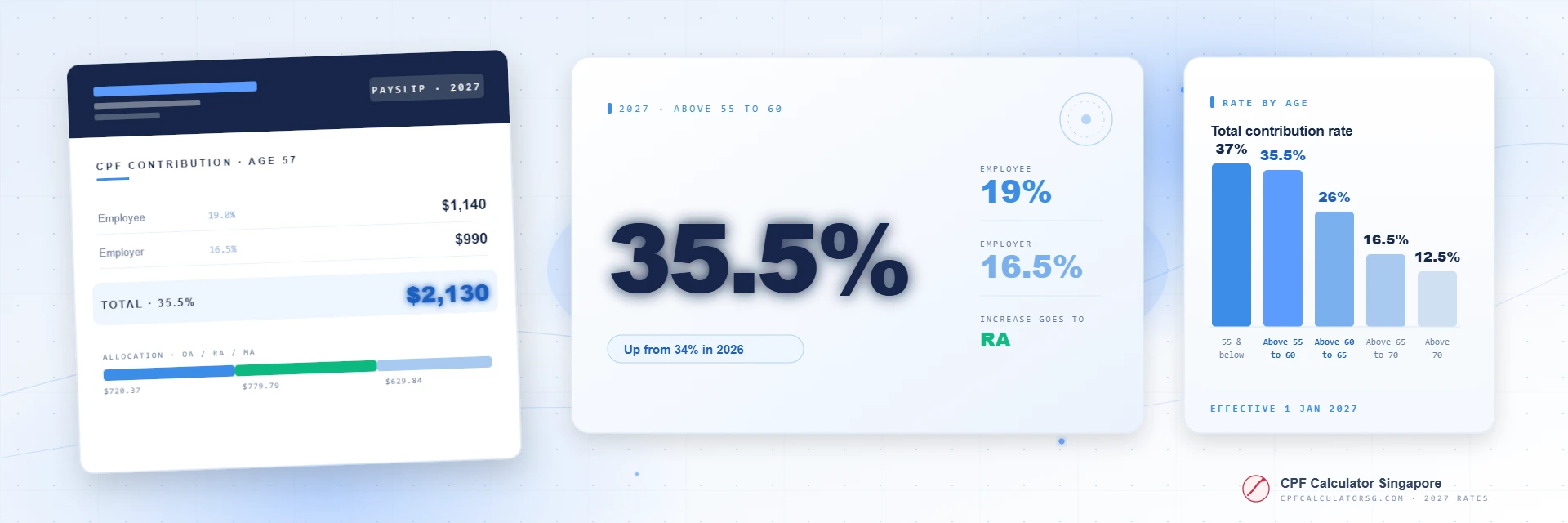
- CPF contribution rates rise on 1 January 2027 for workers aged above 55 to 65. Every other age band is unchanged.
- The employee share carries most of the increase; the employer share rises by half a point in both affected bands.
- The entire increase goes to your Retirement Account, up to your Full Retirement Sum. Your Ordinary Account and MediSave allocations do not move at all.
- The Ordinary Wage ceiling stays at $8,000 a month and the annual salary ceiling stays at $102,000.
- Work out your own figures with the CPF calculator.
CPF Board has published the contribution rate tables that take effect on 1 January 2027. If you are under 55, nothing on your payslip changes. If you are between 55 and 65, your total contribution rate goes up for the third year running — and where that money lands is more interesting than the headline rate.
What Changes on 1 January 2027
Total CPF contribution rates rise for two age bands. Workers aged above 55 to 60 move from 34% to 35.5% of wages, and workers aged above 60 to 65 move from 25% to 26%. The under-55, 65–70 and above-70 bands are untouched.
| Age Group | 2026 Total | 2027 Total | Change | 2027 Employer | 2027 Employee |
|---|---|---|---|---|---|
| 55 & below | 37% | 37% | No change | 17% | 20% |
| Above 55 to 60 | 34% | 35.5% | +1.5 pp | 16.5% | 19% |
| Above 60 to 65 | 25% | 26% | +1 pp | 13% | 13% |
| Above 65 to 70 | 16.5% | 16.5% | No change | 9% | 7.5% |
| Above 70 | 12.5% | 12.5% | No change | 7.5% | 5% |
The bands themselves do not move in 2027. For the current rate at any single age, see the CPF contribution rate by age reference.
Employers costing the change for a payroll rather than a payslip will want the employer CPF contribution rates page, which sets 2026 against 2027 on the employer share alone and gives the maximum cost per employee in each year.
For the cost in dollars rather than percentage points, the 2027 employer cost study computes the extra CPF per employee by age band and wage, with the maximum extra cost per month and per year.
Who Pays for the Increase
The increase is not shared evenly. In both affected bands the employer contributes an extra half a percentage point, while the employee absorbs the rest — a full point for 55 to 60, and half a point for 60 to 65.
| Age Group | Employee Share | Employee Change | Employer Share | Employer Change |
|---|---|---|---|---|
| Above 55 to 60 | 18% → 19% | +1 pp | 16% → 16.5% | +0.5 pp |
| Above 60 to 65 | 12.5% → 13% | +0.5 pp | 12.5% → 13% | +0.5 pp |
In practice that means a slightly smaller take-home figure for workers in these bands, offset by a larger balance in an account they cannot touch until 65.
What the 2027 Rates Cost in Dollars
Rates as percentages are hard to feel. These are the same people on the same salaries, with their 2026 and 2027 monthly contributions computed under CPF Board’s rounding rules: the total rounded to the nearest dollar, the employee share rounded down, and the employer taking the remainder.
| Situation | 2026 Total CPF | 2027 Total CPF | Change | Monthly Take-Home | Take-Home Change |
|---|---|---|---|---|---|
| Mei Lin, 57, on $6,000 a month | $2,040 | $2,130 | +$90 | $4,920 → $4,860 | −$60 |
| Rajan, 62, on $4,500 a month | $1,125 | $1,170 | +$45 | $3,938 → $3,915 | −$23 |
| Daniel, 48, on $6,000 a month | $2,220 | $2,220 | No change | $4,800 → $4,800 | No change |
| Priya, 57, on $10,000 a month | $2,720 | $2,840 | +$120 | $8,560 → $8,480 | −$80 |
Daniel, at 48, sees no change at all — the under-55 rate has been 37% throughout. Priya earns $10,000 but contributes on $8,000, because the Ordinary Wage ceiling caps the wage that attracts CPF. Her contribution rises by the same amount as it would at exactly $8,000.
Where the 2027 Money Goes
CPF Board publishes allocation as a ratio of your total contribution, not as a share of your wage. Multiply each ratio by the total contribution rate for that age band and you get the percentage of wage below — which is why every row sums exactly to the band total.
| Age Group | Ordinary (OA) | Special (SA) | MediSave (MA) | Retirement (RA) | Total |
|---|---|---|---|---|---|
| 35 & below | 23% | 6% | 8% | — | 37% |
| Above 35 to 45 | 21% | 7% | 9% | — | 37% |
| Above 45 to 50 | 19% | 8% | 10% | — | 37% |
| Above 50 to 55 | 15% | 11.5% | 10.5% | — | 37% |
| Above 55 to 60 | 12% | — | 10.5% | 13% | 35.5% |
| Above 60 to 65 | 3.5% | — | 10.5% | 12% | 26% |
| Above 65 to 70 | 1% | — | 10.5% | 5% | 16.5% |
| Above 70 | 1% | — | 10.5% | 1% | 12.5% |
Compare the 55–60 row against 2026 and one thing stands out: the Ordinary Account still receives 12% of wages and MediSave still receives 10.5%, exactly as in 2026. The Retirement Account absorbs the whole 1.5-point increase, moving from 11.5% to 13%. The 60–65 band behaves the same way.
CPF Board says so explicitly in its announcement: the increase “will be fully allocated to the Retirement Account (RA), up to their Full Retirement Sum (FRS)”. If you have already set aside your Full Retirement Sum, the extra contributions are channelled to your Ordinary Account instead.
This is the third consecutive year the increase has been routed this way. We traced all three years account by account in where Singapore’s CPF increases actually go.
The allocation ratios as CPF Board publishes them
| Age Group | Ordinary Account | Special / Retirement | MediSave Account |
|---|---|---|---|
| 35 & below | 0.6217 | 0.1621 (SA) | 0.2162 |
| Above 35 to 45 | 0.5677 | 0.1891 (SA) | 0.2432 |
| Above 45 to 50 | 0.5136 | 0.2162 (SA) | 0.2702 |
| Above 50 to 55 | 0.4055 | 0.3108 (SA) | 0.2837 |
| Above 55 to 60 | 0.3382 | 0.3661 (RA) | 0.2957 |
| Above 60 to 65 | 0.1347 | 0.4615 (RA) | 0.4038 |
| Above 65 to 70 | 0.0607 | 0.303 (RA) | 0.6363 |
| Above 70 | 0.08 | 0.08 (RA) | 0.84 |
Allocation is computed MediSave first, then the Special or Retirement Account, with the Ordinary Account taking whatever remains. That order matters when you check the arithmetic to the cent.
One contribution, followed into the accounts
| Account | 2026 (monthly) | 2027 (monthly) | Change |
|---|---|---|---|
| Ordinary Account | $720.12 | $720.37 | No change (rounding) |
| Retirement Account | $689.93 | $779.79 | +$89.86 |
| MediSave Account | $629.95 | $629.84 | No change (rounding) |
| Total contribution | $2,040 | $2,130 | +$90 |
Rates for Wages of $750 and Below
The headline rates apply to monthly wages above $750. Below that, contributions phase in: no CPF at all on $50 or less, an employer-only contribution between $50 and $500, and a tapering employee share between $500 and $750.
| Age Group | Wages > $50 to $500 | Wages > $500 to $750 | Wages > $750 |
|---|---|---|---|
| 55 & below | 17% of TW | 17% of TW + 0.6 × (TW − $500) | 37% of OW + AW |
| Above 55 to 60 | 16.5% of TW | 16.5% of TW + 0.57 × (TW − $500) | 35.5% of OW + AW |
| Above 60 to 65 | 13% of TW | 13% of TW + 0.39 × (TW − $500) | 26% of OW + AW |
| Above 65 to 70 | 9% of TW | 9% of TW + 0.225 × (TW − $500) | 16.5% of OW + AW |
| Above 70 | 7.5% of TW | 7.5% of TW + 0.15 × (TW − $500) | 12.5% of OW + AW |
In the $500 to $750 band, TW means total wages for the month. The employee’s share is the taper term on its own, so an employee earning $600 in 2027 aged 55 to 60 contributes 0.57 × ($600 − $500) = $57, while the employer covers the balance of the total.
The Ordinary Wage Ceiling in 2027
The Ordinary Wage ceiling remains $8,000 a month in 2027, having completed its stepped increase in January 2026. The annual salary ceiling on total CPF-liable wages stays at $102,000, and the Additional Wage ceiling remains $102,000 minus the ordinary wages that attracted CPF during the year.
Because the ceiling is unchanged, the maximum monthly contribution rises purely because the rates did.
| Age Group | 2026 Total | 2027 Total | Change | 2027 Employee Share |
|---|---|---|---|---|
| 55 & below | $2,960 | $2,960 | No change | $1,600 |
| Above 55 to 60 | $2,720 | $2,840 | +$120 | $1,520 |
| Above 60 to 65 | $2,000 | $2,080 | +$80 | $1,040 |
| Above 65 to 70 | $1,320 | $1,320 | No change | $600 |
| Above 70 | $1,000 | $1,000 | No change | $400 |
Retirement Sums Also Move in 2027
The Retirement Account is where the increase lands, and the target it is measured against rises too. These are the sums that apply to members turning 55 in each year.
| Retirement Sum | Turning 55 in 2026 | Turning 55 in 2027 | Increase |
|---|---|---|---|
| Basic Retirement Sum (BRS) | $110,200 | $114,100 | +$3,900 |
| Full Retirement Sum (FRS) | $220,400 | $228,200 | +$7,800 |
| Enhanced Retirement Sum (ERS) | $440,800 | $456,400 | +$15,600 |
The Full Retirement Sum matters directly here: contributions are allocated to the Retirement Account only up to that figure, after which they go to the Ordinary Account instead.
Three Years of Senior Worker Increases
2027 is not a one-off. Set the three published years side by side and the pattern is consistent.
| Age Group | 2025 | 2026 | 2027 | Change |
|---|---|---|---|---|
| 55 & below | 37% | 37% | 37% | No change |
| Above 55 to 60 | 32.5% | 34% | 35.5% | +3 pp |
| Above 60 to 65 | 23.5% | 25% | 26% | +2.5 pp |
| Above 65 to 70 | 16.5% | 16.5% | 16.5% | No change |
| Above 70 | 12.5% | 12.5% | 12.5% | No change |
If You Are a Permanent Resident
The rates on this page apply to Singapore Citizens and to Permanent Residents from their third year of PR status onwards. First and second year PRs pay graduated rates instead.
CPF Board’s announcement states there are no changes to the graduated rates for first and second year PRs. That is accurate for the default scheme — but not for every PR. We set out which PRs are affected and which are not in CPF rates 2027 for Singapore Permanent Residents.
When the New Rate Starts Applying to You
Two separate timings catch people out:
- The 2027 rates apply to wages payable from 1 January 2027. December 2026 wages paid in January 2027 follow the rules for the month the wages were payable, not the month you were paid.
- Your age band changes in the month after your birthday month. Turn 55 in June and the 55–60 rates first apply to July’s wages.
If you turn 55 or 60 during 2027, both changes can land in the same year.
This page is a reference, not financial advice. It sets out what the published rates are and how they are calculated. What to do about your own CPF depends on circumstances this page knows nothing about.
Frequently Asked Questions
Are the 2027 CPF contribution rates confirmed?
Yes. CPF Board has published the full rate tables for 1 January 2027, covering Singapore Citizens, Permanent Residents in their third year onwards, and first and second year PRs under both graduated schemes, along with the matching allocation rates. They are not a proposal or a projection.
What are the CPF contribution rates in 2027?
For monthly wages above $750: 37% total for age 55 and below (20% employee + 17% employer), 35.5% for above 55 to 60 (19% + 16.5%), 26% for above 60 to 65 (13% + 13%), 16.5% for above 65 to 70 (7.5% + 9%), and 12.5% above 70 (5% + 7.5%).
How much do CPF rates increase in 2027?
Workers aged above 55 to 60 rise 1.5 percentage points, from 34% to 35.5%. Workers aged above 60 to 65 rise 1 percentage point, from 25% to 26%. In both bands the employer pays an extra 0.5 points and the employee pays the remainder. No other age band changes.
Where does the 2027 CPF increase go?
Entirely to the Retirement Account, up to your Full Retirement Sum. The Ordinary Account and MediSave allocations are unchanged from 2026 in both affected bands. If you have already set aside your Full Retirement Sum, the extra contributions go to your Ordinary Account instead.
Does the CPF salary ceiling change in 2027?
No. The Ordinary Wage ceiling stays at $8,000 a month, having finished its stepped increase in January 2026, and the annual salary ceiling on CPF-liable wages stays at $102,000.
Will my take-home pay drop in 2027?
If you are aged above 55 to 65, slightly. The employee share rises by 1 percentage point for 55 to 60 and 0.5 points for 60 to 65, so someone aged 57 earning $6,000 a month contributes $60 more and takes home $60 less. If you are 55 or under, or over 65, nothing changes.
Do 2027 rates apply on my birthday?
No. A new age band applies from the month after your birthday month. If you turn 60 in March 2027, the above-60-to-65 rates first apply to April 2027 wages.