Last reviewed: May 2026 | Next review: January 2027 | Reading time: 9 min
Key Takeaways
- SA earns 4% vs OA's 2.5% — a 1.5% difference that compounds to tens of thousands over 20+ years
- $80,000 in OA grows to ~$148,000 by age 55; the same in SA grows to ~$213,000 — $65,000 difference
- OA→SA transfers are irreversible — once moved, you cannot get it back for housing or emergencies
- A transfer mainly suits money you will not need for property in the next 3–5 years
- Window closes at 55 — after that, SA is merged into RA and transfers are no longer possible
Let's start with a number: $65,000.
That's the approximate difference between leaving $80,000 sitting in your OA versus transferring it to your SA and changing nothing else for 25 years, at CPF Board's floor rates.
- The Ordinary Account at 2.5% a year grows $80,000 to $148,315.53 in 25 years
- The Special Account at 4% a year grows the same $80,000 to $213,266.91
- Difference: $64,951.38, from one transfer and no further action
The transfer itself is a request made in your CPF online account.
This article explains when the transfer makes sense, when it doesn't, and the one permanent consequence to understand before you decide.
OA, SA, MediSave and RA Interest Rates
| Account | Base Interest Rate | Extra 1% Bonus | Effective Rate |
|---|---|---|---|
| Ordinary Account (OA) | 2.5% p.a. | On first $20,000 of OA (combined first $60,000) | 2.5–3.5% |
| Special Account (SA) | 4.0% p.a. | On first $40,000 of SA (combined first $60,000) | 4.0–5.0% |
| MediSave (MA) | 4.0% p.a. | Same combined bonus applies | 4.0–5.0% |
| Retirement Account (RA) | 4.0% p.a. | Extra 1% on first $30,000 (age 55+) | 4.0–5.0% |
The bonus interest works on a combined $60,000 cap across OA+SA+MA (with OA sub-cap of $20,000). From age 55, the bonus applies to the first $30,000 in RA instead.
The 1.5% difference between the OA and SA rates (2.5% vs 4.0%, CPF Board, as at 20 August 2026) looks small in a single year. Over 20 years or more of compounding it is much larger.
The Transfer Is One-Way
A transfer from OA to SA is irreversible, and SA money is not available for emergencies.
Once the money is in SA, it earns 4% and stays there until:
- (a) it gets swept into your RA at age 55, or
- (b) you reach CPF withdrawal eligibility conditionsIf you transfer $30,000 to SA and then find out you need $30,000 for an HDB downpayment next year, you cannot retrieve it. That money is no longer available for the downpayment.
Before you transfer: Log into my.cpf.gov.sg and check your current SA balance against the Full Retirement Sum ($220,400 for 2026). If you're already at or above the FRS, no transfer is possible.
Calculate your exact CPF contributions based on your salary, age and citizenship status.
Open the Free CPF Calculator →The $65,000 Visualised
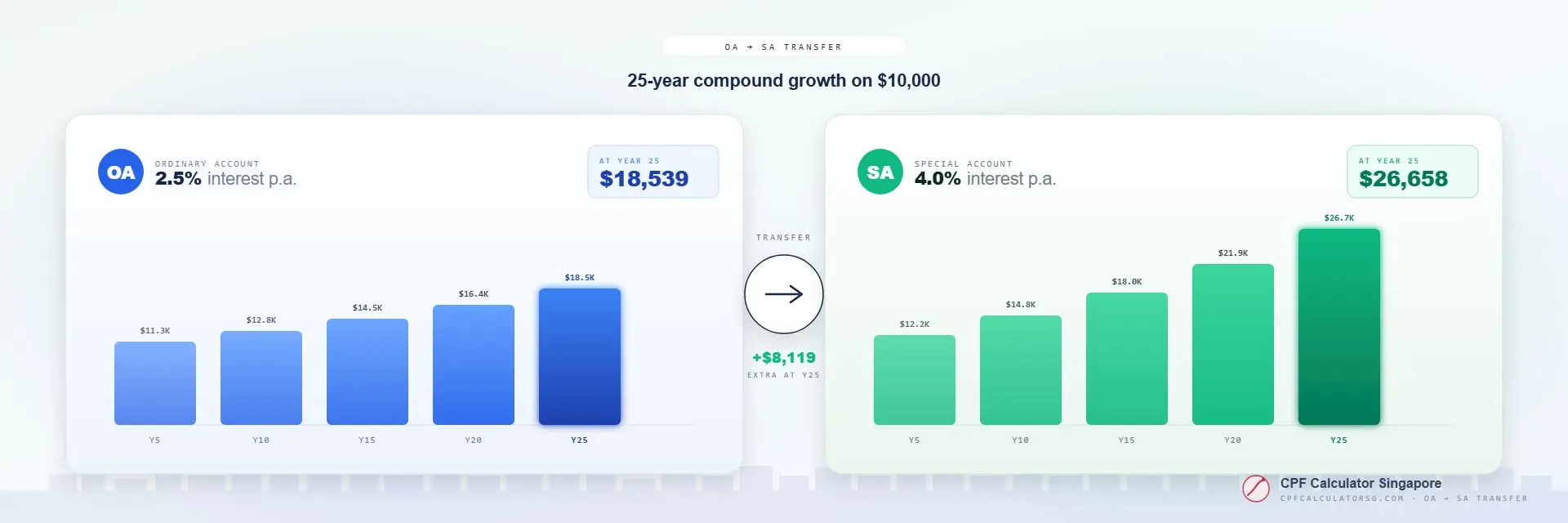
The short answer: Moving $80,000 from the Ordinary Account to the Special Account at 30 is worth $64,951.38 more by 55 — and permanently removes it from anything to do with housing.
| Time from the transfer | Left in the Ordinary Account | Transferred to the Special Account |
|---|---|---|
| After 5 years (age 35) | $90,512.66 in the Ordinary Account at 2.5% | $97,332.23 in the Special Account at 4% — $6,819.57 ahead |
| After 10 years (age 40) | $102,406.76 in the Ordinary Account at 2.5% | $118,419.54 in the Special Account at 4% — $16,012.78 ahead |
| After 15 years (age 45) | $115,863.85 in the Ordinary Account at 2.5% | $144,075.48 in the Special Account at 4% — $28,211.63 ahead |
| After 20 years (age 50) | $131,089.32 in the Ordinary Account at 2.5% | $175,289.85 in the Special Account at 4% — $44,200.53 ahead |
| After 25 years (age 55) | $148,315.53 in the Ordinary Account at 2.5% | $213,266.91 in the Special Account at 4% — $64,951.38 ahead |
| Tax relief on the transfer | Relief is for cash top-ups only, never for a transfer between your own accounts | $0 |
| What you give up | Ordinary Account money can pay for a home; Special Account money cannot, and the transfer cannot be reversed | — |
How this was computed: Both columns use CPF’s published floor rates (2.5% and 4%), held flat and compounded yearly, with extra interest ignored — including it widens the gap slightly rather than narrowing it. The transfer earns no tax relief, which is the single most common misunderstanding about it.
The longer the horizon, the larger the gap. If you're 30 and transfer $80,000 to SA, you have 25 years of compounding before age 55. That's where the gap comes from.
Three Decision Scenarios
Scenario A: James, 35, not buying a house soon
James has $45,000 in OA, $18,000 in SA. He's renting and has no immediate plans to buy property.
Does a transfer fit? Possibly. With no purchase planned, the OA money is not needed for housing, and a transfer is allowed up to the SA cap (the Full Retirement Sum: $220,400 for 2026).
$45,000 transferred to SA earns 1.5% more per year — that's $675/year more interest on that balance alone. Over 20 years at compound rates, the difference adds up.
How much buffer to leave in OA is a personal call. Some people keep 3–6 months of estimated housing costs there as a precaution and consider transferring the rest.
See exactly how much James's transfer is worth → cpfcalculatorsg.com/calculator.html
Scenario B: Raj, 28, buying an HDB in 2 years
Raj has $15,000 in OA, plans to use it as part of his HDB downpayment.
Does a transfer fit? Not yet. Not while the OA money is still earmarked for the purchase.
HDB downpayments and stamp duties must come from OA — SA cannot be used for housing. If Raj transfers his OA to SA now, he loses the housing flexibility and must fund the downpayment with cash instead.
Once the purchase is complete and the OA balance is no longer needed for housing, a transfer becomes an option.
Not sure how much OA to protect? The HDB Affordability Calculator shows your required downpayment and monthly CPF draw based on your income, flat price, and loan type.
Scenario C: Mei Lin, 52, within 3 years of 55
Mei Lin has $120,000 in OA, $60,000 in SA. No outstanding housing loan.
Does a transfer fit? Likely worth weighing soon, because the window closes at 55.
At 55, the SA is merged into her RA and she can no longer make transfers to SA. Any OA balance she hasn't transferred by then stays in OA at 2.5%.
The exact amount to transfer depends on her FRS target ($220,400 for those turning 55 in 2026). She would work out how much to transfer to reach it, which also sets her CPF LIFE payouts.
Time matters here: each month the money stays in OA earns 2.5% instead of 4.0%.
The SA Cap: How Much Can You Transfer?
You cannot transfer unlimited amounts to the Special Account. The cap is the Full Retirement Sum (FRS): $220,400 for those turning 55 in 2026, and $228,200 for the 2027 cohort.
Once your SA balance reaches the FRS, no further OA-to-SA transfer is permitted, however much OA you are holding. The FRS is revised every 1 January and applies to the cohort turning 55 that year: across the last 4 cohorts the step has been $7,000 to $7,800. Your own figure locks at the year you turn 55 and never rises again.
After 55: The Rules Change
Once you turn 55:
- Your SA is merged into your RA (up to the FRS amount)
- OA-to-SA transfers are no longer possible
- If you want to top up your RA after 55, you do so directly to RA — not via SA
- Cash top-ups to RA after 55 still qualify for tax relief up to $8,000/year
This is why the window matters for Mei Lin. Once 55 passes, the SA premium interest rate (4% vs 2.5%) is captured in the RA, but the transfer mechanism closes.
Tax Relief on Cash Top-Ups
Cash top-ups to SA (before 55) and RA (after 55) are tax-deductible under the Retirement Sum Topping-Up (RSTU) scheme:
- Up to $8,000/year in cash top-ups to your own SA/RA: full tax relief
- Up to an additional $8,000/year in cash top-ups to a family member's SA/RA: additional tax relief
Example: Mei Lin tops up $8,000 in cash to her SA in 2026. Her chargeable income is $75,000. At the 11.5% marginal rate, this saves her approximately $920 in tax this year — while the $8,000 earns 4% in SA. Counting the tax saved, the first-year return on that $8,000 is higher than 4%.
Note: OA-to-SA transfers (moving money already in CPF) do not generate tax relief. Only cash top-ups from outside the CPF system qualify for the RSTU tax deduction.
What About CPF LIFE?
The SA top-up strategy feeds directly into CPF LIFE payout amounts.
More in SA → more swept into RA at 55 → higher RA balance → higher CPF LIFE monthly payouts.
CPF LIFE is a lifelong annuity — the payout is calculated based on your RA balance at the point payouts begin (you can choose from 65 to 70). A higher RA from an OA-to-SA transfer is one way to raise your monthly retirement income.
For context:
- Basic Retirement Sum ($110,200): ~$900–$1,000/month CPF LIFE payout from 65
- Full Retirement Sum ($220,400): ~
$1,780/month
CPF LIFE payout from 65
(Use the CPF LIFE estimator at my.cpf.gov.sg for your personalised projection)
How Housing Plans Change the Decision
If you own a fully paid-off HDB with no plans to upgrade, your OA is not needed for housing, which is the case where a transfer is most often considered.
If you're actively paying a mortgage, your OA is doing useful work — but amounts above your projected top-up needs for the next 3–5 years could still be transferred.
If you're planning an upgrade (HDB to condo, resale, etc.) within 5 years, a common approach is to keep OA funded.
A rule of thumb: OA is the housing account and SA is the retirement account. Moving money from one to the other is worth considering once major housing spending is behind you.
How to Make the Transfer
- Log in to my.cpf.gov.sg with Singpass
- Go to My Requests → Building Up My / My Recipient's CPF Savings → Transfer from OA to SA/RA
- Enter the amount (up to the FRS cap)
- Confirm — the transfer takes effect immediately
- You will receive a confirmation letter
There is no reversal step, so check the amount before you confirm.
Model the interest impact first → cpfcalculatorsg.com/calculator.html
Frequently Asked Questions
Can I transfer my SA back to my OA?
No. The OA-to-SA transfer is irreversible. It is a permanent, one-direction move and CPF Board will not undo it.
What if I need emergency cash after transferring everything to SA?
Special Account money is not available for emergencies. CPF is a retirement mandate, not a savings account, so you would have to draw on other liquid assets. This is the central risk of an aggressive transfer.
Does the transfer affect my CPF LIFE eligibility?
No. CPF LIFE eligibility rests on your citizenship status and your Retirement Account balance, not on which account the money came from. A larger SA simply means a larger RA at 55, and a larger payout.
What is the maximum I can transfer from OA to SA?
The transfer is capped so that your Special Account does not exceed the current Full Retirement Sum, $220,400 in 2026. If your SA is already at or above that, no transfer is allowed.
I am 53 — is it too late to benefit?
No. Even two years at 4% instead of 2.5% on a large balance is real money, and the more important effect is the size of the Retirement Account created at 55, which sets your CPF LIFE payout for life.
Does an OA-to-SA transfer give me a tax deduction?
No. Only cash top-ups made from outside CPF qualify for RSTU relief. Moving money between two accounts you already own is not a taxable event and generates no relief.
Can I transfer from my OA to my spouse’s SA?
No — an OA-to-SA transfer works only within your own accounts. What you can do is make a cash top-up to your spouse’s account and claim the family member relief, up to $8,000 a year on top of the $8,000 for yourself.
What happens to my SA balance if I die before 55?
Your CPF balance, Special Account included, is distributed under your CPF nomination. Without a nomination it goes to the Public Trustee for distribution under intestacy rules.
What if I transfer too much and then need my OA for housing?
You cannot reverse it. The money is locked until 55, when it becomes your Retirement Account. This is why the transfer decision should only cover money you are certain you will not need for a property.
Is the $64,951.38 difference in the example guaranteed?
No. It uses the statutory floor rates — 2.5% for the OA and 4% for the SA — on $80,000 left alone for 25 years, with extra interest and any withdrawal ignored. Actual rates can be higher, and using the OA for housing makes the real gap smaller.
Can I use my SA for the CPF Investment Scheme?
No. Special Account balances cannot be invested under CPFIS. Only Ordinary Account money above $20,000 is eligible, which is a reason to keep some funds in the OA if you intend to invest.
What happens to SA above the FRS at 55?
Only up to the Full Retirement Sum, $220,400 in 2026, is swept into the Retirement Account. Anything above that can be withdrawn under the usual withdrawal rules, or left where it is to keep earning 4%.
The Situations Above at a Glance
| Your situation | Does a transfer fit? |
|---|---|
| Under 55, not buying property in next 3 years | It can, for excess OA |
| Under 55, buying HDB/condo in next 3 years | Not while OA is needed for housing |
| Under 55, mortgage ongoing | Possibly, for the excess only |
| Age 50–54, SA below FRS | Worth weighing before the window closes at 55 |
| Age 55+ | OA-to-SA transfers no longer possible; top up RA directly |
| SA already at FRS cap ($220,400) | No transfer possible |
Know someone with a large CPF OA balance and no plan for it? Share this page with them.
Written by the team at CPF Calculator SG. Figures based on CPF Board published rates effective 1 January 2026. For the authoritative source, visit cpf.gov.sg. This article is for general information only and does not constitute financial advice. Next review: January 2027.