CPF Contribution Rates for PRs
1st year, 2nd year and 3rd year onwards — all five CPF Board tables in one
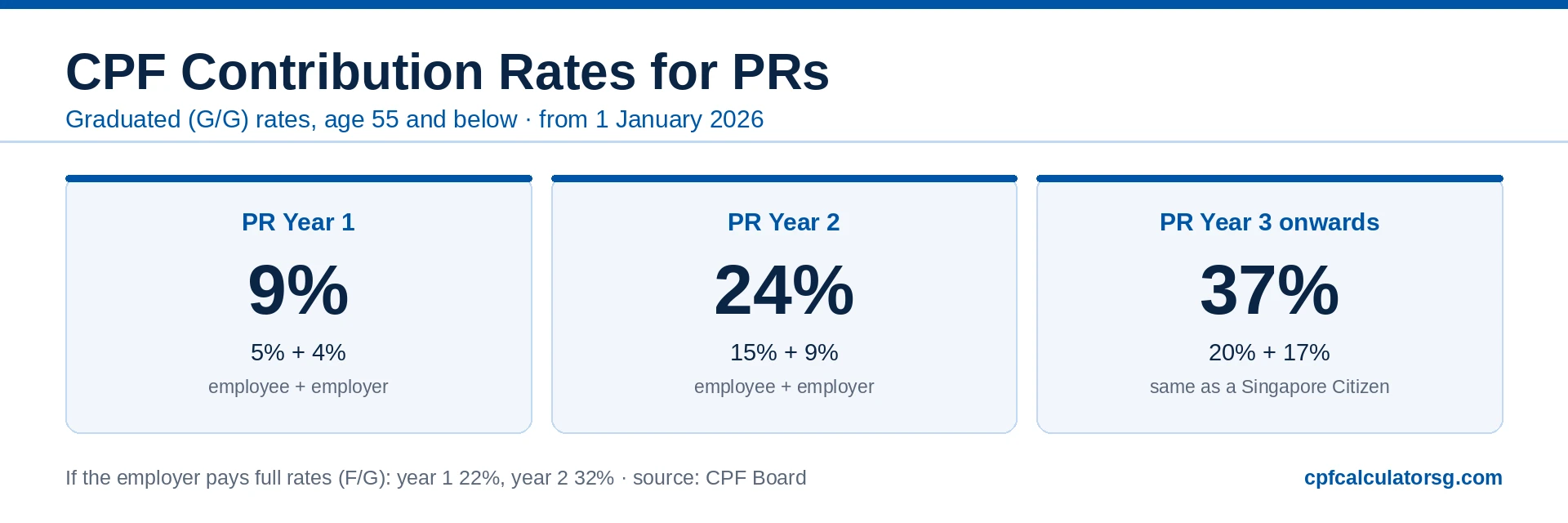
Find Your PR Year and Age
One row per PR year and age band — both rate tables side by sideCPF Board publishes five separate tables and expects you to work out which
one you are on before you can read a rate off it. This table is all five at once. Find the
row for your PR year and your age band; read the G/G columns unless your employer has
applied to pay the full employer rate, in which case read the F/G columns. Each row has its
own link, so /#pr-year2-55-60 lands on the row for a 2nd-year PR aged 57.
| PR year | Age band | Graduated (G/G) — the default | Full employer / graduated employee (F/G) | ||||
|---|---|---|---|---|---|---|---|
| Employee | Employer | Total | Employee | Employer | Total | ||
| 1st year | 55 & below | 5% | 4% | 9% | 5% | 17% | 22% |
| 1st year | Above 55 to 60 | 5% | 4% | 9% | 5% | 16% | 21% |
| 1st year | Above 60 to 65 | 5% | 3.5% | 8.5% | 5% | 12.5% | 17.5% |
| 1st year | Above 65 to 70 | 5% | 3.5% | 8.5% | 5% | 9% | 14% |
| 1st year | Above 70 | 5% | 3.5% | 8.5% | 5% | 7.5% | 12.5% |
| 2nd year | 55 & below | 15% | 9% | 24% | 15% | 17% | 32% |
| 2nd year | Above 55 to 60 | 12.5% | 6% | 18.5% | 12.5% | 16% | 28.5% |
| 2nd year | Above 60 to 65 | 7.5% | 3.5% | 11% | 7.5% | 12.5% | 20% |
| 2nd year | Above 65 to 70 | 5% | 3.5% | 8.5% | 5% | 9% | 14% |
| 2nd year | Above 70 | 5% | 3.5% | 8.5% | 5% | 7.5% | 12.5% |
| 3rd year onwards (same as Table 1) | 55 & below | 20% | 17% | 37% | 20% | 17% | 37% |
| 3rd year onwards | Above 55 to 60 | 18% | 16% | 34% | 18% | 16% | 34% |
| 3rd year onwards | Above 60 to 65 | 12.5% | 12.5% | 25% | 12.5% | 12.5% | 25% |
| 3rd year onwards | Above 65 to 70 | 7.5% | 9% | 16.5% | 7.5% | 9% | 16.5% |
| 3rd year onwards | Above 70 | 5% | 7.5% | 12.5% | 5% | 7.5% | 12.5% |
All figures are percentages of wage. G/G is the default: it applies to every new PR unless the employer has applied to CPF Board to pay more. F/G applies only where the employer has made that application — the employer pays the full rate while the employee stays on the graduated one. From the 3rd year both columns are the same table, because the graduated rates have ended. CPF Board publishes the G/G tables with a single “above 65” band; the above 65 to 70 and above 70 rows carry that same figure.
G/G or F/G: Which Table Applies to You
The default, the employer’s application, and the joint applicationG/G — graduated employer, graduated employee. Both sides pay a reduced rate for the first two years. This is the default: it applies to every new PR automatically, and it is what the great majority of PRs are on.
F/G — full employer, graduated employee. The employer pays the full rate while you stay on the graduated one. It applies only where the employer has applied to CPF Board for it. Your own take-home pay is identical to G/G; what changes is how much lands in your CPF, and it is your employer’s decision, not yours.
Full rates from year 1. An employer and employee can also jointly apply to contribute at full rates on both sides from the first year. Where CPF Board approves that application, the graduated tables are skipped entirely and Table 1 applies — the same rates a citizen pays. The PR graduated rates guide covers when that is worth asking for.
Employers applying these tables to a payroll will also want the employer CPF contribution rates page, which carries the employer share for citizens and PRs together with the ceilings and the annual cap.
Where a PR’s CPF Actually Goes
Allocation across the accounts, as a percentage of wageCPF Board publishes one allocation table, not one per PR year: the ratios are ratios of the total contribution, and they do not change with citizenship or with PR year. So a 1st-year PR splits their contribution in exactly the same proportions as a citizen of the same age — it is the total being split that is smaller. Below, that is worked through as a percentage of wage, which is the form the split is usually asked about.
| PR year | Allocation age band | Total | To OA | To SA / RA | To MA |
|---|---|---|---|---|---|
| 1st year | 35 & below | 9% | 5.59% | 1.46% (SA) | 1.95% |
| 1st year | Above 35 to 45 | 9% | 5.11% | 1.7% (SA) | 2.19% |
| 1st year | Above 45 to 50 | 9% | 4.62% | 1.95% (SA) | 2.43% |
| 1st year | Above 50 to 55 | 9% | 3.65% | 2.8% (SA) | 2.55% |
| 1st year | Above 55 to 60 | 9% | 3.18% | 3.04% (RA) | 2.78% |
| 1st year | Above 60 to 65 | 8.5% | 1.19% | 3.74% (RA) | 3.57% |
| 1st year | Above 65 to 70 | 8.5% | 0.51% | 2.58% (RA) | 5.41% |
| 1st year | Above 70 | 8.5% | 0.68% | 0.68% (RA) | 7.14% |
| 2nd year | 35 & below | 24% | 14.92% | 3.89% (SA) | 5.19% |
| 2nd year | Above 35 to 45 | 24% | 13.62% | 4.54% (SA) | 5.84% |
| 2nd year | Above 45 to 50 | 24% | 12.33% | 5.19% (SA) | 6.48% |
| 2nd year | Above 50 to 55 | 24% | 9.73% | 7.46% (SA) | 6.81% |
| 2nd year | Above 55 to 60 | 18.5% | 6.53% | 6.26% (RA) | 5.71% |
| 2nd year | Above 60 to 65 | 11% | 1.54% | 4.84% (RA) | 4.62% |
| 2nd year | Above 65 to 70 | 8.5% | 0.51% | 2.58% (RA) | 5.41% |
| 2nd year | Above 70 | 8.5% | 0.68% | 0.68% (RA) | 7.14% |
| 3rd year onwards | 35 & below | 37% | 23% | 6% (SA) | 8% |
| 3rd year onwards | Above 35 to 45 | 37% | 21% | 7% (SA) | 9% |
| 3rd year onwards | Above 45 to 50 | 37% | 19% | 8% (SA) | 10% |
| 3rd year onwards | Above 50 to 55 | 37% | 15% | 11.5% (SA) | 10.5% |
| 3rd year onwards | Above 55 to 60 | 34% | 12% | 11.5% (RA) | 10.5% |
| 3rd year onwards | Above 60 to 65 | 25% | 3.5% | 11% (RA) | 10.5% |
| 3rd year onwards | Above 65 to 70 | 16.5% | 1% | 5% (RA) | 10.5% |
| 3rd year onwards | Above 70 | 12.5% | 1% | 1% (RA) | 10.5% |
Percentages of wage, on the graduated (G/G) rates. CPF Board does not publish a separate allocation table for PRs: it publishes ratios of the total contribution, and those ratios are the same whatever the total is. A PR in year 1 aged 35 or below therefore splits their contribution 62.2% / 16.2% / 21.6% across OA, SA and MediSave exactly as a citizen does — it is the total being split that is smaller. Allocation is banded more finely than contribution, which is why this table has eight age bands where the one above has five.
What Happens to Take-Home Pay
The two transitions, and what each one costs a monthNothing about your gross salary changes when a PR year ends, but your own CPF share rises twice, and both times your take-home pay falls without any negotiation having taken place. The larger of the two steps is the first one, from year 1 to year 2. The employer’s share rises at the same time, so the total going into your CPF rises by more than your take-home falls — the money is not lost, it is redirected.
| Age band | PR 1st year | PR 2nd year | 3rd year onwards | Total fall | Fall per $1,000 of wage |
|---|---|---|---|---|---|
| 55 & below | $7,600 | $6,800 | $6,400 | $1,200 | $150 |
| Above 55 to 60 | $7,600 | $7,000 | $6,560 | $1,040 | $130 |
| Above 60 to 65 | $7,600 | $7,400 | $7,000 | $600 | $75 |
| Above 65 to 70 | $7,600 | $7,600 | $7,400 | $200 | $25 |
| Above 70 | $7,600 | $7,600 | $7,600 | $0 | $0 |
On the graduated (G/G) rates, at a wage of $8,000 a month — the 2026 Ordinary Wage ceiling, so these are also the figures for anyone earning more than that. Below the ceiling the fall is proportional to the wage, which is what the last column gives: multiply it by your monthly wage in thousands. Gross pay does not change at either transition. What changes is the employee share, and the employer’s share rises at the same time, so the total going into your CPF rises by more than your take-home falls.
What Changes Next Year
Already published by CPF BoardThe graduated rates themselves are the most stable figures in the whole CPF system: the G/G tables have not changed since 1 January 2016. What does move is the full employer rate for older workers, and that shows up in the F/G tables and in the 3rd-year column immediately.
| Age band | G/G 1st year | G/G 2nd year | F/G 1st year | F/G 2nd year | 3rd year onwards |
|---|---|---|---|---|---|
| 55 & below | 9% | 24% | 22% | 32% | 37% |
| Above 55 to 60 | 9% | 18.5% | 21% → 21.5% (+0.5 pp) | 28.5% → 29% (+0.5 pp) | 34% → 35.5% (+1.5 pp) |
| Above 60 to 65 | 8.5% | 11% | 17.5% → 18% (+0.5 pp) | 20% → 20.5% (+0.5 pp) | 25% → 26% (+1 pp) |
| Above 65 to 70 | 8.5% | 8.5% | 14% | 14% | 16.5% |
| Above 70 | 8.5% | 8.5% | 12.5% | 12.5% | 12.5% |
Totals as a percentage of wage; the cells that move are marked. 6 of the 25 figures change on 1 January 2027. The graduated G/G rates have not changed since 1 January 2016 and do not change next year either. What moves is the employer side: the F/G tables carry the full employer rate, so every increase to the full rate shows up there, and in the 3rd-year-onwards column, immediately.
Common Questions
Direct answers, each traced to the same source tablesWhat is the CPF contribution rate for a PR in 2026?
It depends on how long you have been a PR. In the 1st year of PR status, at 55 and below, it is 9% of wage in total — 5% from you and 4% from your employer. In the 2nd year it is 24% of wage in total — 15% from you and 9% from your employer. From the 3rd year you are on the same full rates as a citizen: 37% of wage in total — 20% from you and 17% from your employer. Older age bands pay less at every stage.
What is the CPF rate for a 1st year PR?
9% of wage in total — 5% from you and 4% from your employer at 55 and below, on the graduated (G/G) rates that apply by default. Above 55 to 60 it is 9%, and above 60 it is 8.5%. If your employer has applied to pay the full employer rate (F/G), your own share is unchanged but the total rises to 22%.
What is the PR 2nd year CPF contribution rate?
24% of wage in total — 15% from you and 9% from your employer at 55 and below. Your own share triples between year 1 and year 2 — from 5% to 15% of wage — which is the single largest change in the whole sequence and the one that surprises people on their payslip.
When does my PR year 1 become year 2?
PR year 1 runs from the month your PR status took effect, as stated on the Entry Permit issued by ICA, and the graduated rate for the next year applies from the first day of the month after each anniversary. It is not counted from the date you were hired, from the date you collected your NRIC, or from the start of the calendar year. Time spent in Singapore on an Employment Pass before PR does not count.
Do PRs pay less CPF than citizens?
Only for the first two years. From the 3rd year of PR status the rates are identical to a citizen's, and so is everything else — the Ordinary Wage ceiling of $8,000 a month, the annual salary ceiling of $102,000, the allocation ratios, the interest rates and the retirement sums. There is no permanent discount and no permanent penalty.
What is the difference between G/G and F/G rates?
G/G means graduated employer and graduated employee: both sides pay a reduced rate, and this is what applies automatically. F/G means full employer and graduated employee: the employer pays the full rate while the employee stays on the graduated one. F/G applies only where the employer has applied to CPF Board for it. An employer and employee can also jointly apply to pay full rates on both sides from year 1, in which case CPF Board's Table 1 rates apply and the graduated tables are skipped entirely.
How much does my take-home pay fall between PR year 1 and year 3?
At 55 and below, your own contribution goes from 5% of wage to 20%, so take-home falls by 15% of wage in total — $800 a month at the first transition and a further $400 at the second, on a $8,000 wage. Gross pay has not changed; the money is going into your CPF instead, along with a larger employer contribution.
Do PR rates change in 2027?
The graduated G/G rates do not — they have not changed since 1 January 2016. The F/G tables do, for ages above 55 to 65, because they carry the full employer rate and that rate is still rising: F/G 1st year above 55 to 60 goes from 21% to 21.5%. PRs in their 3rd year onwards are on the full rates and see the full increase.
Is the Ordinary Wage ceiling the same for PRs?
Yes. The ceiling of $8,000 a month applies to PRs in every year of PR status, exactly as it does to citizens. Wage above it attracts no CPF at all, so a 1st-year PR earning $16,000 contributes the same as a 1st-year PR earning $8,000.