CPF Contribution Rate by Age
Every age band, and a row for every single age — from CPF Board’s own tables
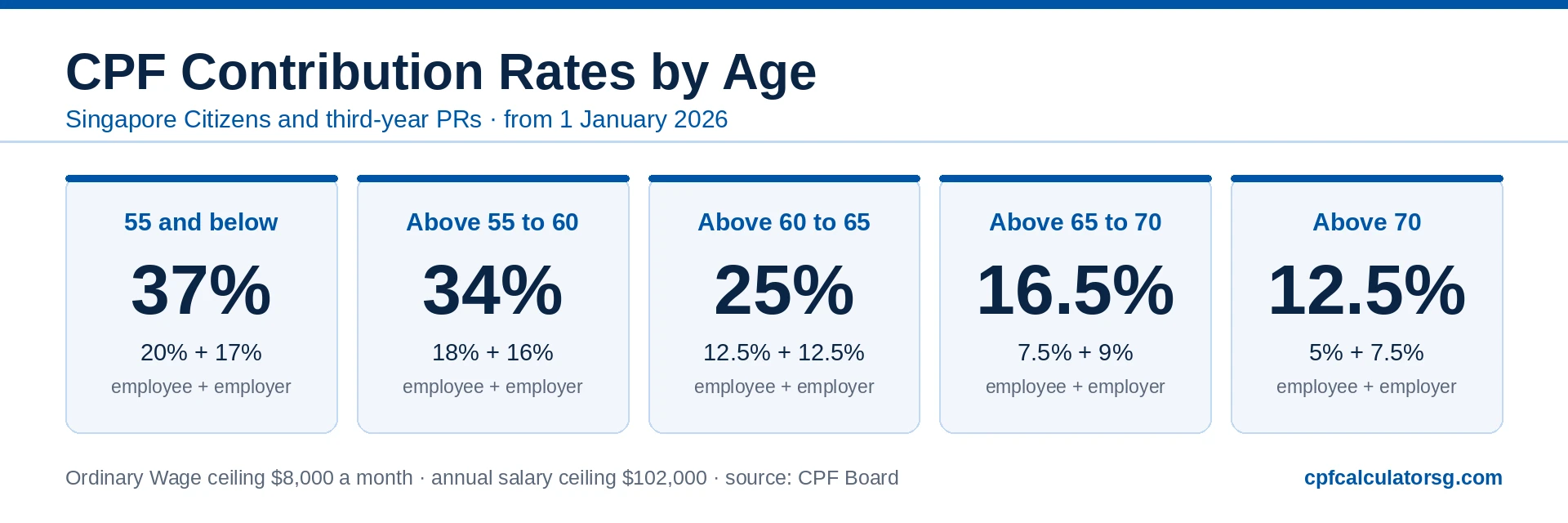
The Five CPF Age Bands
What you and your employer each contribute, as a percentage of wageCPF Board publishes contribution rates in five age bands, and the rate falls at every boundary. Both shares fall, so take-home pay rises each time and the total going into your CPF falls. Nothing about this is a choice: the band is set by your age and your employer applies it.
| Age Group | Employee | Employer | Total |
|---|---|---|---|
| 55 & below | 20% | 17% | 37% |
| Above 55 to 60 | 18% | 16% | 34% |
| Above 60 to 65 | 12.5% | 12.5% | 25% |
| Above 65 to 70 | 7.5% | 9% | 16.5% |
| Above 70 | 5% | 7.5% | 12.5% |
To see what those contributions add up to across all members at every age, see the average CPF balance by age.
Find Your Own Age
One row per age — contribution and allocation togetherCPF Board publishes bands; most people arrive knowing only their age. This table resolves one into the other. Every row is derived from the band tables above by the same code that runs the calculator, so the two cannot give different answers. The four highlighted rows are the ages at which something changes.
| Age (last birthday) | CPF age band | Total | Employee | Employer | To OA | To SA / RA | To MA |
|---|---|---|---|---|---|---|---|
| 50 | 55 & below | 37% | 20% | 17% | 19% | 8% (SA) | 10% |
| 51 | 55 & below | 37% | 20% | 17% | 15% | 11.5% (SA) | 10.5% |
| 52 | 55 & below | 37% | 20% | 17% | 15% | 11.5% (SA) | 10.5% |
| 53 | 55 & below | 37% | 20% | 17% | 15% | 11.5% (SA) | 10.5% |
| 54 | 55 & below | 37% | 20% | 17% | 15% | 11.5% (SA) | 10.5% |
| 55 | 55 & below | 37% | 20% | 17% | 15% | 11.5% (SA) | 10.5% |
| 56 | Above 55 to 60 | 34% | 18% | 16% | 12% | 11.5% (RA) | 10.5% |
| 57 | Above 55 to 60 | 34% | 18% | 16% | 12% | 11.5% (RA) | 10.5% |
| 58 | Above 55 to 60 | 34% | 18% | 16% | 12% | 11.5% (RA) | 10.5% |
| 59 | Above 55 to 60 | 34% | 18% | 16% | 12% | 11.5% (RA) | 10.5% |
| 60 | Above 55 to 60 | 34% | 18% | 16% | 12% | 11.5% (RA) | 10.5% |
| 61 | Above 60 to 65 | 25% | 12.5% | 12.5% | 3.5% | 11% (RA) | 10.5% |
| 62 | Above 60 to 65 | 25% | 12.5% | 12.5% | 3.5% | 11% (RA) | 10.5% |
| 63 | Above 60 to 65 | 25% | 12.5% | 12.5% | 3.5% | 11% (RA) | 10.5% |
| 64 | Above 60 to 65 | 25% | 12.5% | 12.5% | 3.5% | 11% (RA) | 10.5% |
| 65 | Above 60 to 65 | 25% | 12.5% | 12.5% | 3.5% | 11% (RA) | 10.5% |
| 66 | Above 65 to 70 | 16.5% | 7.5% | 9% | 1% | 5% (RA) | 10.5% |
| 67 | Above 65 to 70 | 16.5% | 7.5% | 9% | 1% | 5% (RA) | 10.5% |
| 68 | Above 65 to 70 | 16.5% | 7.5% | 9% | 1% | 5% (RA) | 10.5% |
| 69 | Above 65 to 70 | 16.5% | 7.5% | 9% | 1% | 5% (RA) | 10.5% |
| 70 | Above 65 to 70 | 16.5% | 7.5% | 9% | 1% | 5% (RA) | 10.5% |
| 71 and above | Above 70 | 12.5% | 5% | 7.5% | 1% | 1% (RA) | 10.5% |
Contribution columns are percentages of wage. The last three columns are where that contribution is allocated, also as a percentage of wage, so the three of them add up to the total. Age 50 is the last year of the “above 45 to 50” allocation band, which is why its split differs from 51’s while the contribution rate is identical. Every age below 50 is on the same 55 & below contribution rate; the allocation bands below 50 are in the allocation table further down this page. A new rate applies from the first day of the month after your birthday month.
What Changes at 55, 60, 65 and 70
The four boundaries, and what moves at eachAt 55: total falls from 37% to 34%
Your share goes from 20% to 18% of wage and your employer’s from 17% to 16%, so take-home pay rises and the total saved falls. Where the money lands changes too: the Ordinary Account’s share of wage drops from 15% to 12%, and MediSave’s does not move at all — it stays at 10.5% of wage. The Special Account stops receiving contributions and the Retirement Account starts: the 11.5% of wage that went to your SA goes to your RA instead. The change takes effect from the first day of the month after your 55th birthday.
At 60: total falls from 34% to 25%
Your share goes from 18% to 12.5% of wage and your employer’s from 16% to 12.5%, so take-home pay rises and the total saved falls. Where the money lands changes too: the Ordinary Account’s share of wage drops from 12% to 3.5%, the Retirement Account’s goes from 11.5% to 11%, and MediSave’s does not move at all — it stays at 10.5% of wage. The change takes effect from the first day of the month after your 60th birthday.
At 65: total falls from 25% to 16.5%
Your share goes from 12.5% to 7.5% of wage and your employer’s from 12.5% to 9%, so take-home pay rises and the total saved falls. Where the money lands changes too: the Ordinary Account’s share of wage drops from 3.5% to 1%, the Retirement Account’s goes from 11% to 5%, and MediSave’s does not move at all — it stays at 10.5% of wage. The change takes effect from the first day of the month after your 65th birthday.
At 70: total falls from 16.5% to 12.5%
Your share goes from 7.5% to 5% of wage and your employer’s from 9% to 7.5%, so take-home pay rises and the total saved falls. Where the money lands changes too: the Retirement Account’s goes from 5% to 1%, and MediSave’s does not move at all — it stays at 10.5% of wage. The change takes effect from the first day of the month after your 70th birthday.
Where the Money Goes, by Age
Allocation across the accounts, as a percentage of wageAllocation is banded more finely than contribution: it changes at 35, 45 and 50 as well as at 55, 60, 65 and 70. The pattern is consistent across all of them — the Ordinary Account’s share of wage falls steeply with age while MediSave’s rises to a plateau, and from 56 the Special Account stops receiving contributions altogether and the Retirement Account takes its place.
| Age Group | Ordinary (OA) | Special (SA) | MediSave (MA) | Retirement (RA) | Total |
|---|---|---|---|---|---|
| 35 & below | 23% | 6% | 8% | — | 37% |
| Above 35 to 45 | 21% | 7% | 9% | — | 37% |
| Above 45 to 50 | 19% | 8% | 10% | — | 37% |
| Above 50 to 55 | 15% | 11.5% | 10.5% | — | 37% |
| Above 55 to 60 | 12% | — | 10.5% | 11.5% | 34% |
| Above 60 to 65 | 3.5% | — | 10.5% | 11% | 25% |
| Above 65 to 70 | 1% | — | 10.5% | 5% | 16.5% |
| Above 70 | 1% | — | 10.5% | 1% | 12.5% |
These are the rates for citizens and for PRs from their 3rd year. A PR in the first two years is on a graduated table instead: see the CPF contribution rates for PRs reference.
For the employer’s side of these rates on its own — the cost per employee per month and per year, in 2026 and 2027 — see the employer CPF contribution rates reference.
The Monthly Ceiling for Each Age
The most that can be contributed on ordinary wages, whatever you earnWage above the Ordinary Wage ceiling attracts no CPF at all, so every age band has a hard monthly maximum. Anyone earning at or above the ceiling contributes exactly these figures, whether they earn a little above it or a great deal above it.
| Age Group | Total rate | Max total per month | Max from you | Max from employer |
|---|---|---|---|---|
| 55 & below | 37% | $2,960 | $1,600 | $1,360 |
| Above 55 to 60 | 34% | $2,720 | $1,440 | $1,280 |
| Above 60 to 65 | 25% | $2,000 | $1,000 | $1,000 |
| Above 65 to 70 | 16.5% | $1,320 | $600 | $720 |
| Above 70 | 12.5% | $1,000 | $400 | $600 |
Ordinary Wage ceiling in 2026: $8,000 a month. Wage above the ceiling attracts no CPF, so these are the figures for anyone earning at or above it, at any salary. The annual salary ceiling across ordinary and additional wages is $102,000.
What Changes Next Year
Already published by CPF BoardTwo of the five bands move on 1 January 2027, and both of them are older bands: the rates for workers over 55 continue the multi-year climb towards parity with the under-55 rate. The bands themselves are unchanged.
| Age Group | 2026 Total | 2027 Total | Change | 2027 Employer | 2027 Employee |
|---|---|---|---|---|---|
| 55 & below | 37% | 37% | No change | 17% | 20% |
| Above 55 to 60 | 34% | 35.5% | +1.5 pp | 16.5% | 19% |
| Above 60 to 65 | 25% | 26% | +1 pp | 13% | 13% |
| Above 65 to 70 | 16.5% | 16.5% | No change | 9% | 7.5% |
| Above 70 | 12.5% | 12.5% | No change | 7.5% | 5% |
Common Questions
Direct answers, each traced to the same source tablesWhat is the CPF contribution rate by age in 2026?
The rate falls at four ages. 55 and below: 37% total (20% employee, 17% employer); above 55 to 60: 34% total (18% employee, 16% employer); above 60 to 65: 25% total (12.5% employee, 12.5% employer); above 65 to 70: 16.5% total (7.5% employee, 9% employer); above 70: 12.5% total (5% employee, 7.5% employer).
What is the CPF contribution rate at age 55?
At 55 you are still in CPF Board’s “55 and below” band, so the rate is 37% of wage in total — 20% from you and 17% from your employer. Of your wage, 15% goes to the Ordinary Account, 11.5% to the Special Account and 10.5% to MediSave. The next band (above 55 to 60, 34%) starts from the first day of the month after your 55th birthday, not on the birthday itself.
What is the CPF contribution rate for a 57-year-old?
A 57-year-old is in the “above 55 to 60” band: 34% of wage in total — 18% from you and 16% from your employer. Of your wage, 12% goes to the Ordinary Account, 11.5% to the Retirement Account and 10.5% to MediSave. The same figures apply at 56, 58, 59 and 60.
What is the CPF contribution rate for age 60?
At 60 you are in the “above 55 to 60” band: 34% of wage in total — 18% from you and 16% from your employer. Of your wage, 12% goes to the Ordinary Account, 11.5% to the Retirement Account and 10.5% to MediSave. The “above 60 to 65” rate of 25% applies from the month after your 60th birthday.
What is the CPF contribution rate for age 65 and above?
From the month after your 65th birthday until 70, the rate is 16.5% of wage in total — 7.5% from you and 9% from your employer. Above 70 it is 12.5% of wage in total — 5% from you and 7.5% from your employer. There is no age at which CPF contributions stop while you are still working.
Does the rate change on my birthday?
No. CPF Board applies the new band from the first day of the month after your birthday month. If you turn 60 in March, the March payroll is still on the old rate and April is the first month on the new one.
Which account do my contributions go to at each age?
Up to 55, contributions split between the Ordinary, Special and MediSave Accounts. From 56 the Special Account stops receiving contributions and the Retirement Account takes its place. MediSave’s share of wage climbs from 8% at 35 and below to 10% in the above 45 to 50 band, and then holds at 10.5% for every band above that, including above 70. What actually shrinks with age is the Ordinary Account: 23% of wage at 35 and below against 1% above 70.
Do the age bands change in 2027?
The bands themselves do not; the rates inside two of them do. In 2027: above 55 to 60 34% → 35.5%; above 60 to 65 25% → 26%. The Ordinary Wage ceiling is $8,000 a month.