Key Takeaways
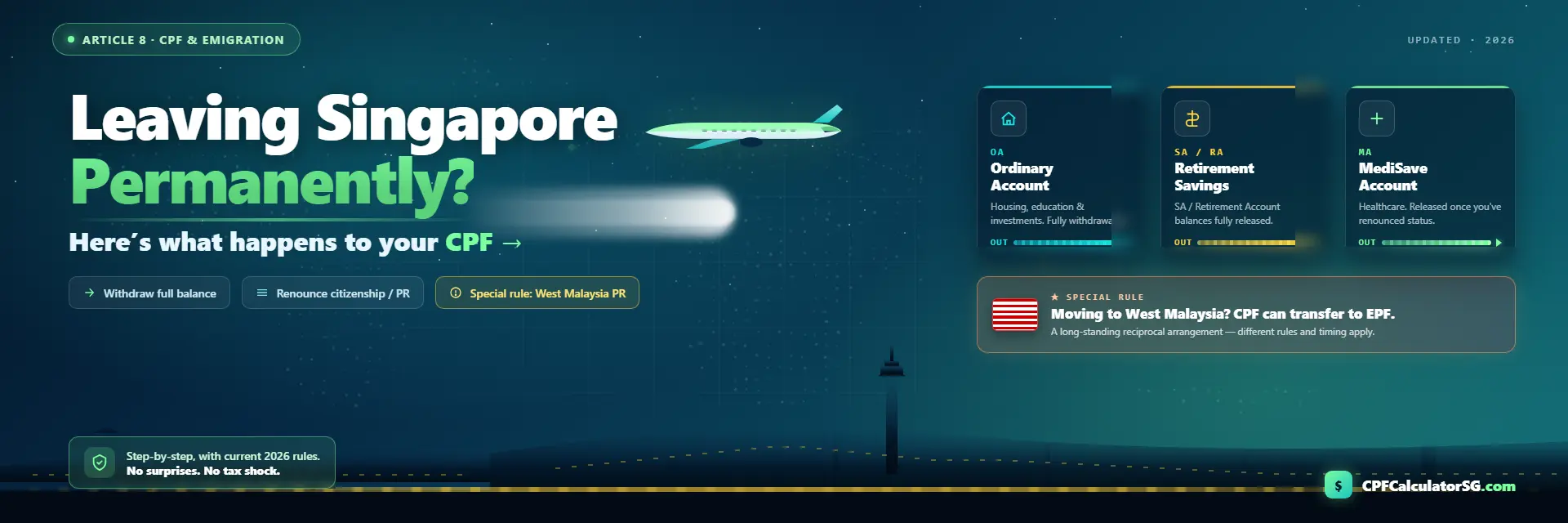
- Non-citizens and PRs who renounce their status can withdraw all CPF balances — OA, SA, and MA — upon permanent departure
- Singaporeans who renounce citizenship can also withdraw in full once citizenship is formally renounced
- MediSave withdrawal on departure: full MA balance if you are under 65; above the Basic Healthcare Sum ($79,000 in 2026) only if you are 65 or above
- CPF LIFE policies are cancelled on full withdrawal — you receive a refund of premiums with interest, not the annuity value
- There is no Singapore tax on CPF withdrawals upon permanent departure
- Processing takes 10–14 business days after all documents are received — apply before you cancel your Singpass
Malaysian PRs: This section is especially for you.
If you are a Malaysian citizen who held Singapore PR status and are renouncing that PR, you can withdraw your entire CPF balance — OA, SA, MA, and RA (if over 55) — once ICA has processed your PR renunciation. Many Malaysians are unaware the full balance is accessible, or that the process is straightforward once ICA is done.
Important: Apply before you cancel your Singpass — you need Singpass to log in to my.cpf.gov.sg and submit the withdrawal application. Once your Singpass is deactivated, submitting becomes significantly more complicated.
Malaysian residents are generally not taxed on CPF withdrawal receipts under current Malaysian tax rules — but confirm this with a Malaysian tax adviser before proceeding, as individual circumstances vary.
Who Can Withdraw CPF on Permanent Departure?
CPF withdrawal on departure is available in two scenarios:
1. Renouncing Singapore Citizenship or PR status
- Singapore Citizens who renounce citizenship
- Permanent Residents who formally withdraw PR status
CPF Board requires proof that the renunciation has been processed — a notification from the Immigration and Checkpoints Authority (ICA) confirming the change in status.
2. Non-citizens and non-PRs who are leaving Singapore permanently
In practice, most Employment Pass holders do not contribute to CPF. The majority of CPF withdrawal on departure cases involve Malaysian PRs returning to Malaysia, and former Singaporeans who have renounced citizenship to take up foreign nationality.
Can I Withdraw? Quick Reference
| Status | OA? | SA/RA? | MA? |
|---|---|---|---|
| Singapore Citizen renouncing | Yes — full balance | Yes — full balance | Yes — full if under 65; above BHS ($79,000) if 65+ |
| PR renouncing | Yes — full balance | Yes — full balance | Yes — full if under 65; above BHS ($79,000) if 65+ |
| EP/WP holder departing permanently (with CPF contributions) | Yes — full balance | Yes — full balance | Yes — full if under 65 |
| EP holder who never contributed to CPF | N/A — no CPF | N/A | N/A |
Note: In the vast majority of departure cases, the person is under 65 and can withdraw the full MA balance.
Which Accounts Can Be Withdrawn?
Ordinary Account (OA)
The full OA balance can be withdrawn upon meeting the departure eligibility criteria.
Special Account (SA)
The full SA balance can be withdrawn. Note that if you are over 55, your SA will have been closed and its funds transferred to a Retirement Account (RA) — the RA balance is what you would withdraw instead.
Retirement Account (RA) — for those over 55
If you have a Retirement Account, you can withdraw the full RA balance, including any amounts already transferred from SA into RA at age 55.
MediSave Account (MA)
- Under 65 years old: You can withdraw the full MA balance
- 65 and above: You can withdraw the amount above the Basic Healthcare Sum (BHS), which is $79,000 in 2026. The BHS amount itself is retained.
What Happens to CPF LIFE?
If you are enrolled in CPF LIFE (the mandatory annuity scheme for those with sufficient balances at 55), the scheme is cancelled upon full CPF withdrawal.
You do not receive the annuity value. Instead, you receive a refund of:
- The premiums you paid into CPF LIFE, plus
- The interest these premiums earned while held in the scheme
For most people departing before 65, CPF LIFE cancellation with a full principal-plus-interest refund is broadly fair. The annuity value would only exceed the refund value if you were to live well past the break-even age (typically around 82–85 for the Standard Plan).
What About CPF Investments?
If you have used CPF funds to purchase investments through the CPF Investment Scheme (CPFIS), those investments must be liquidated before you can withdraw the CPF balance. You cannot transfer CPFIS investments out of Singapore.
The process:
- Sell all CPFIS holdings (unit trusts, shares, ETFs, T-bills) through your bank or brokerage
- Proceeds are credited back to your OA automatically
- Once all investments are liquidated, proceed with the withdrawal application
Timing matters: liquidation of listed securities typically takes 2–3 business days; some unit trusts may take longer.
Tax Treatment of CPF Withdrawals
CPF withdrawals — including departure withdrawals — are not subject to Singapore income tax. This applies to both the principal and the accumulated interest. Singapore does not impose an exit tax on CPF balances.
However, your destination country's tax rules are a separate matter. Some countries treat foreign pension or provident fund receipts as taxable income. If you are moving to a country with comprehensive tax rules on foreign pension treatment, obtain tax advice in the destination country before applying for CPF withdrawal.
Worked Example: What Withdrawing at 40 Actually Costs
The short answer: Withdrawing $150,000 at 40 gives up $91,929.90 of guaranteed CPF interest that the same balances would have earned by age 55.
| Step | Working | Figure |
|---|---|---|
| Ordinary Account balance | Withdrawn in full on renunciation | $80,000 |
| Special Account balance | Withdrawn in full | $45,000 |
| MediSave Account balance | Also withdrawable once citizenship or PR status is renounced | $25,000 |
| Cash withdrawn today | All three accounts | $150,000 |
| The same Ordinary Account at 55 | 2.5% a year for 15 years | $115,863.85 |
| The same Special Account at 55 | 4% a year for 15 years | $81,042.46 |
| The same MediSave Account at 55 | 4% a year for 15 years | $45,023.59 |
| What the balances would have become | Left untouched to age 55 | $241,929.90 |
| The cost of withdrawing at 40 | $241,929.90 − $150,000 | $91,929.90 |
How this was computed: Balances are an illustration; the interest rates are CPF’s published floor rates, held flat for 15 years and compounded yearly, with extra interest ignored. This is the opportunity cost only — it is not an argument for or against leaving, and money withdrawn can of course be invested elsewhere.
The Withdrawal Process: Step by Step
Step 1: Confirm your eligibility
Log into my.cpf.gov.sg with your Singpass to check your balances. Confirm your departure eligibility category.
Step 2: Complete ICA process first
CPF withdrawal requires documentation from ICA confirming your change of status. For PR renunciation, complete the ICA PR renunciation process first. Processing time for ICA varies; allow at least several weeks.
Step 3: Liquidate CPF investments
If you hold CPFIS assets, sell them and ensure proceeds are back in your OA before applying.
Step 4: Apply for CPF withdrawal
Submit the withdrawal application via my.cpf.gov.sg (Retirement section → Withdrawal of CPF savings upon renunciation or departure). You will need:
- NRIC / FIN
- ICA confirmation of status change
- Bank account details for payment
- Completed CPF withdrawal form (available on cpf.gov.sg)
Step 5: Wait for processing
CPF Board typically processes withdrawal applications within 10–14 business days of receiving all required documents.
Safe deadline note: Do not leave this until the day you fly — processing can be delayed if documents are incomplete or if there are outstanding CPFIS investments to liquidate. Apply before you cancel your Singpass.
Frequently Asked Questions
Can I leave Singapore and come back later to withdraw my CPF?
Yes. There is no requirement to withdraw immediately on departure. Your CPF balances continue to earn interest while you are abroad. Many former PRs take their time — months or even years — before formally applying for withdrawal.
What if I want to keep my CPF and come back to Singapore someday?
If you retain your Singapore PR or citizenship, you keep your CPF. If you have renounced, you cannot reinstate CPF membership — withdrawal is one-way. Once you renounce and withdraw, you cannot re-join the CPF system.
Can I nominate someone to receive my CPF if I die before withdrawing?
Yes. CPF nomination rules apply regardless of where you live. Without a valid nomination, CPF balances are distributed by the Public Trustee to your legal beneficiaries. Nominate through my.cpf.gov.sg.
Do I have to close my CPF accounts after withdrawal?
CPF accounts are automatically closed after a full withdrawal. Partial withdrawals on departure are not permitted — it is all or nothing.
What if my CPF balance has housing refunds due?
If you used CPF for property and still own that property, you cannot withdraw the CPF tied to it until the property is sold and the refund made. See our CPF for HDB Property article for details on the accrued interest refund process.
Can I withdraw if I'm just moving abroad temporarily, not permanently?
No. CPF withdrawal on departure is only for permanent departure — defined as renouncing citizenship/PR, or being a foreign national leaving with no intention to return.
Written by the team at CPF Calculator SG. Reviewed against CPF Board policies effective January 2026. For the authoritative source, visit cpf.gov.sg. This article is for general information only and does not constitute financial or legal advice. Tax treatment in your destination country should be verified with a qualified adviser in that jurisdiction.