Key Takeaways
- First and second year PRs pay graduated CPF rates. From the third year onwards they pay full Citizen rates.
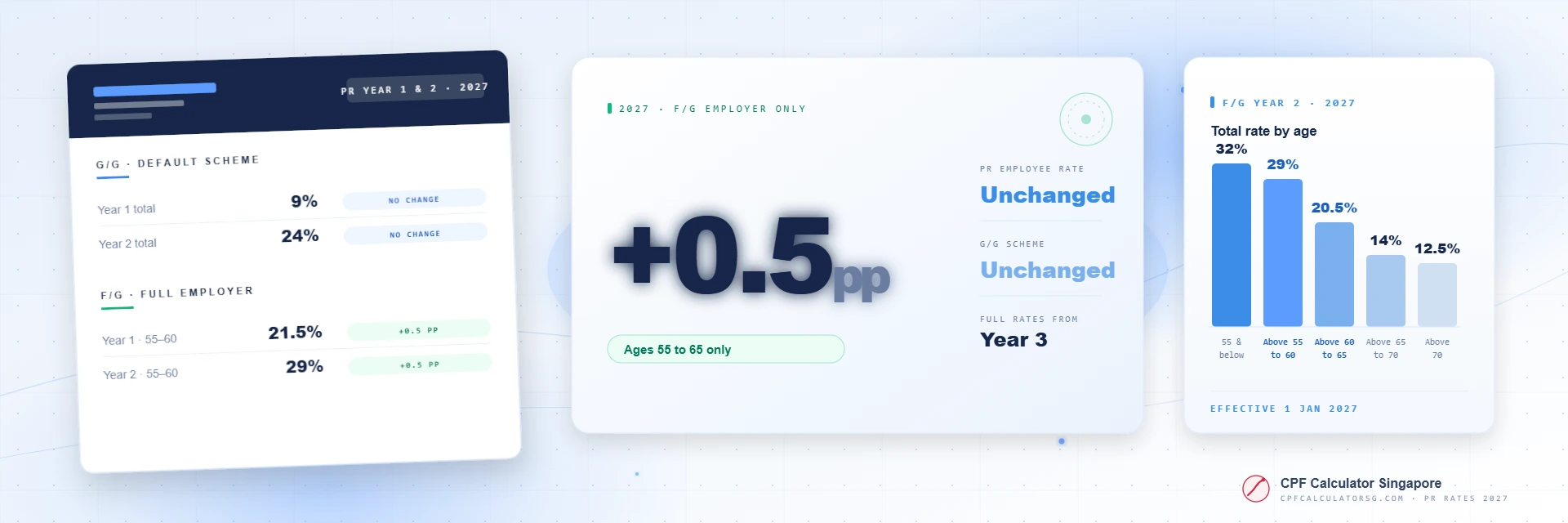
- CPF Board states there are no changes to graduated rates in 2027. That is true for the default G/G scheme, which is unchanged in every age band.
- It is not true for PRs on the F/G scheme, where the employer pays the full employer rate. Because the employer rate rises in 2027, F/G totals rise too for ages 55 to 65.
- Which scheme you are on is a joint decision between you and your employer, applied for through CPF Board.
- Check your own figures with the CPF calculator.
New Permanent Residents do not start on full CPF rates. For the first two years of PR status, contributions are phased in on a graduated scale, so that take-home pay does not fall off a cliff the month PR is granted.
For the current year’s rates rather than 2027’s, in a single table covering both schemes and all three PR years, see the CPF contribution rates for PRs reference.
The Two Graduated Schemes
There are two ways a first or second year PR can contribute, and the difference is entirely on the employer’s side.
- G/G — graduated employer, graduated employee. The default. Both sides pay reduced rates during years one and two.
- F/G — full employer, graduated employee. The employer pays the full employer rate immediately, while the employee still pays the reduced graduated rate. This requires a joint application by employer and employee, approved by CPF Board.
Both sides can also jointly apply to contribute at full rates from the start, in which case the ordinary 2027 Citizen rates apply.
“Year 1” runs from the date PR status is obtained to the end of the month of the first anniversary, and “year 2” to the end of the month of the second anniversary, per CPF Board — not from January.
What CPF Board Announced, and What It Leaves Out
CPF Board’s announcement of the 2027 changes states plainly that there are no changes to the graduated contribution rates for first and second year PRs.
Read against the published tables, that statement holds for the G/G scheme and only the G/G scheme. The F/G tables do change for ages 55 to 65, because the F/G employer pays the full employer rate — and the full employer rate rises by half a percentage point in 2027 for both of those bands. The employee side of F/G is genuinely unchanged; the total is not.
If you are a first or second year PR aged 55 to 65 on the F/G scheme, your total 2027 contribution is higher than your 2026 one, even though the announcement says graduated rates are unchanged.
G/G Rates for 2027 — Unchanged
These are the default graduated rates. Every figure is identical to 2026.
Year 1 PR, graduated (G/G)
| Age Group | Employee (2027) | Employer 2026 → 2027 | 2026 Total | 2027 Total | Change |
|---|---|---|---|---|---|
| 55 & below | 5% | 4% → 4% | 9% | 9% | No change |
| Above 55 to 60 | 5% | 4% → 4% | 9% | 9% | No change |
| Above 60 to 65 | 5% | 3.5% → 3.5% | 8.5% | 8.5% | No change |
| Above 65 | 5% | 3.5% → 3.5% | 8.5% | 8.5% | No change |
Year 2 PR, graduated (G/G)
| Age Group | Employee (2027) | Employer 2026 → 2027 | 2026 Total | 2027 Total | Change |
|---|---|---|---|---|---|
| 55 & below | 15% | 9% → 9% | 24% | 24% | No change |
| Above 55 to 60 | 12.5% | 6% → 6% | 18.5% | 18.5% | No change |
| Above 60 to 65 | 7.5% | 3.5% → 3.5% | 11% | 11% | No change |
| Above 65 | 5% | 3.5% → 3.5% | 8.5% | 8.5% | No change |
F/G Rates for 2027 — Higher for Ages 55 to 65
Under F/G the employee rate matches the G/G employee rate, but the employer pays the full employer rate for the employee’s age. The rows below that changed are the ones where the underlying employer rate moved.
Year 1 PR, full employer / graduated employee (F/G)
| Age Group | Employee (2027) | Employer 2026 → 2027 | 2026 Total | 2027 Total | Change |
|---|---|---|---|---|---|
| 55 & below | 5% | 17% → 17% | 22% | 22% | No change |
| Above 55 to 60 | 5% | 16% → 16.5% | 21% | 21.5% | +0.5 pp |
| Above 60 to 65 | 5% | 12.5% → 13% | 17.5% | 18% | +0.5 pp |
| Above 65 to 70 | 5% | 9% → 9% | 14% | 14% | No change |
| Above 70 | 5% | 7.5% → 7.5% | 12.5% | 12.5% | No change |
Year 2 PR, full employer / graduated employee (F/G)
| Age Group | Employee (2027) | Employer 2026 → 2027 | 2026 Total | 2027 Total | Change |
|---|---|---|---|---|---|
| 55 & below | 15% | 17% → 17% | 32% | 32% | No change |
| Above 55 to 60 | 12.5% | 16% → 16.5% | 28.5% | 29% | +0.5 pp |
| Above 60 to 65 | 7.5% | 12.5% → 13% | 20% | 20.5% | +0.5 pp |
| Above 65 to 70 | 5% | 9% → 9% | 14% | 14% | No change |
| Above 70 | 5% | 7.5% → 7.5% | 12.5% | 12.5% | No change |
In each case the increase is 0.5 percentage points and falls entirely on the employer. No PR employee’s own contribution rate changes in 2027 under either scheme.
The Same PR, Under Each Scheme
One worker, one salary, four different tables. This is a 58-year-old PR earning $5,000 a month, with contributions computed under CPF Board’s rounding rules.
| PR Year and Scheme | 2027 Employee | 2027 Employer | 2026 Total | 2027 Total | Change |
|---|---|---|---|---|---|
| Year 1 PR, graduated (G/G) | $250 | $200 | $450 | $450 | No change |
| Year 1 PR, full employer (F/G) | $250 | $825 | $1,050 | $1,075 | +$25 |
| Year 2 PR, graduated (G/G) | $625 | $300 | $925 | $925 | No change |
| Year 2 PR, full employer (F/G) | $625 | $825 | $1,425 | $1,450 | +$25 |
The gap between schemes is large and it is the employer’s money: at year 1, F/G costs the employer several times what G/G does, for identical take-home pay. That is why F/G is an application rather than a default.
After Year Two
From the third year of PR status onwards, graduated rates stop and full rates apply — the same rates a Singapore Citizen of the same age pays. Those are set out in full on our CPF contribution rates 2027 page, and for PRs in that position the 2027 increase applies exactly as it does for Citizens.
The transition happens in the month after your second PR anniversary, in the same way age bands change the month after a birthday.
Allocation Works the Same Way
PR status changes how much goes into CPF, not where it goes. Allocation across the Ordinary, Special or Retirement, and MediSave accounts follows the same age-based ratios that apply to Citizens, applied to whatever total was contributed. A first year PR contributes less, so each account receives less, in the same proportions.
This page is a reference, not financial advice. It sets out what the published rates are and how they are calculated. What to do about your own CPF depends on circumstances this page knows nothing about.
Frequently Asked Questions
Do CPF rates change for Permanent Residents in 2027?
For PRs in their third year onwards, yes — they pay full rates, which rise for ages 55 to 65. For first and second year PRs on the default graduated (G/G) scheme, no: every G/G figure is unchanged. For first and second year PRs on the full employer / graduated employee (F/G) scheme, yes for ages 55 to 65, because the employer pays the full employer rate and that rate rises by 0.5 percentage points.
What are the 2027 CPF rates for a first year PR?
Under the default G/G scheme: 9% total (5% employee + 4% employer) for age 55 and below and for above 55 to 60, and 8.5% total (5% employee + 3.5% employer) above 60. Under F/G the employee still pays 5%, while the employer pays the full employer rate for the employee’s age — 17% for 55 and below, 16.5% for above 55 to 60, and 13% for above 60 to 65 in 2027.
What are the 2027 CPF rates for a second year PR?
Under G/G: 24% total (15% employee + 9% employer) for age 55 and below, 18.5% (12.5% + 6%) for above 55 to 60, 11% (7.5% + 3.5%) for above 60 to 65, and 8.5% (5% + 3.5%) above 65. Under F/G the employee rates are the same but the employer pays the full employer rate, giving 32%, 29%, 20.5%, 14% and 12.5% totals by age band in 2027.
What is the difference between G/G and F/G CPF rates?
G/G means graduated employer and graduated employee — both sides pay reduced rates during the first two years of PR status, and it is the default. F/G means full employer, graduated employee — the employer pays the full employer rate straight away while the employee stays on the reduced rate. F/G requires a joint application by employer and employee to CPF Board.
Does a PR employee pay more CPF in 2027?
No. No PR employee’s own contribution rate changes in 2027 under either graduated scheme. The only graduated-rate increases in 2027 fall on the employer, under F/G, for employees aged 55 to 65.
When do PRs start paying full CPF rates?
From the third year of PR status. Year 1 runs from the date PR status is obtained to the end of the month of the first anniversary, year 2 to the end of the month of the second anniversary, and full rates apply from the month after that. Employer and employee can also jointly apply to pay full rates earlier.