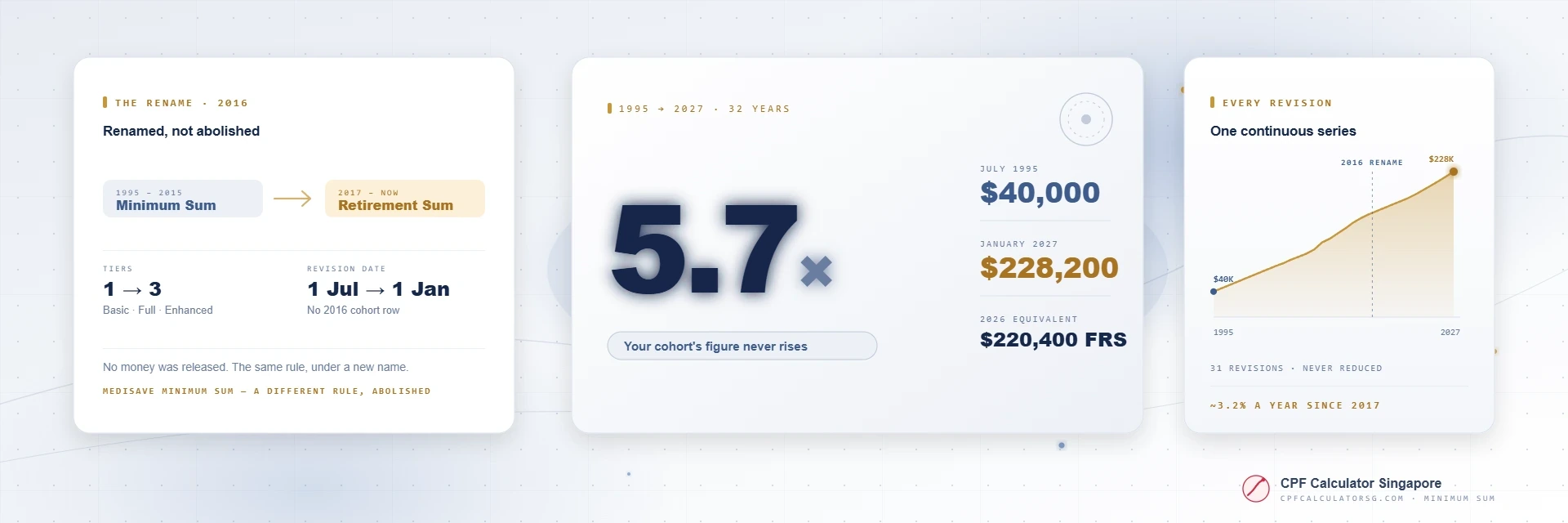
The short answer: the CPF Minimum Sum no longer exists under that name. CPF Board renamed it the Retirement Sum in 2016. The figure people mean when they say “minimum sum” is the Full Retirement Sum, which is $220,400 for members turning 55 in 2026. If you own a property and pledge it, you can set aside the Basic Retirement Sum of $110,200 instead.
| Since 2016 it is called… | Amount to set aside at 55 in 2026 | CPF LIFE payout from 65 | Who it applies to |
|---|---|---|---|
| Basic Retirement Sum (BRS) | $110,200 | $950 a month | You own a property and pledge it to CPF |
| Full Retirement Sum (FRS) | $220,400 | $1,780 a month | The default. This is the old Minimum Sum |
| Enhanced Retirement Sum (ERS) | $440,800 | $3,440 a month | You choose to top up for a larger payout |
The retirement requirement was not abolished and no money was released. The same rule applies under a different name, with more room at the top and a lower option for property owners. If someone told you the Minimum Sum was scrapped, they were describing either the rename or a different rule altogether — the MediSave Minimum Sum, which genuinely was abolished in 2016 and is covered further down.
This page is a reference, not financial advice. It sets out what the published rates are and how they are calculated. What to do about your own CPF depends on circumstances this page knows nothing about.
Why the Name Changed
Two things changed at once, which is part of why the old name has stuck. The sum was renamed the Retirement Sum in 2016 and split into three tiers, and the revision date moved from 1 July to 1 January. CPF Board’s own table runs straight from a 1 July 2015 cohort at $161,000 to a 1 January 2017 cohort at $166,000 — there is no 2016 row, because the 2015 cohort ran to the end of that year.
The old single figure asked one question of everyone: have you set aside enough? The three tiers ask a better one, which is how much monthly income you want and what you are prepared to lock up to get it. Someone who owns their flat outright and expects modest expenses is measured against a different number from someone who wants the largest annuity CPF will sell them.
The word “minimum” was also doing real damage. It read as a floor everyone had to clear or else, when the actual consequence of falling short has always been a smaller monthly payout and nothing more — no fine, no penalty, no forfeiture. That is covered in full in our guide to the 2026 retirement sums.
Every Minimum Sum and Full Retirement Sum Since 1995
In one line: the sum a member must set aside at 55 has risen from $40,000 in 1995 to $228,200 in 2027 — 5.7 times over 32 years — and CPF Board publishes the whole run as one series, under two different names.
| 55th birthday on or after | Called | Amount to set aside | Rise on the previous revision |
|---|---|---|---|
| July 1995 | Minimum Sum | $40,000 | — |
| July 1996 | Minimum Sum | $45,000 | +$5,000 |
| July 1997 | Minimum Sum | $50,000 | +$5,000 |
| July 1998 | Minimum Sum | $55,000 | +$5,000 |
| July 1999 | Minimum Sum | $60,000 | +$5,000 |
| July 2000 | Minimum Sum | $65,000 | +$5,000 |
| July 2001 | Minimum Sum | $70,000 | +$5,000 |
| July 2002 | Minimum Sum | $75,000 | +$5,000 |
| July 2003 | Minimum Sum | $80,000 | +$5,000 |
| July 2004 | Minimum Sum | $84,500 | +$4,500 |
| July 2005 | Minimum Sum | $90,000 | +$5,500 |
| July 2006 | Minimum Sum | $94,600 | +$4,600 |
| July 2007 | Minimum Sum | $99,600 | +$5,000 |
| July 2008 | Minimum Sum | $106,000 | +$6,400 |
| July 2009 | Minimum Sum | $117,000 | +$11,000 |
| July 2010 | Minimum Sum | $123,000 | +$6,000 |
| July 2011 | Minimum Sum | $131,000 | +$8,000 |
| July 2012 | Minimum Sum | $139,000 | +$8,000 |
| July 2013 | Minimum Sum | $148,000 | +$9,000 |
| July 2014 | Minimum Sum | $155,000 | +$7,000 |
| July 2015 | Minimum Sum | $161,000 | +$6,000 |
| January 2017 | Full Retirement Sum | $166,000 | +$5,000 |
| January 2018 | Full Retirement Sum | $171,000 | +$5,000 |
| January 2019 | Full Retirement Sum | $176,000 | +$5,000 |
| January 2020 | Full Retirement Sum | $181,000 | +$5,000 |
| January 2021 | Full Retirement Sum | $186,000 | +$5,000 |
| January 2022 | Full Retirement Sum | $192,000 | +$6,000 |
| January 2023 | Full Retirement Sum | $198,800 | +$6,800 |
| January 2024 | Full Retirement Sum | $205,800 | +$7,000 |
| January 2025 | Full Retirement Sum | $213,000 | +$7,200 |
| January 2026 | Full Retirement Sum | $220,400 | +$7,400 |
| January 2027 | Full Retirement Sum | $228,200 | +$7,800 |
Find the row for the year you turn 55, not the row for this year. That figure is fixed for the rest of your life and never rises again once your birthday passes — someone who turned 55 in 1995 is still measured against $40,000, not against 2026’s $220,400. This is the single most common misreading of the table above.
The Other “Minimum Sum”: MediSave
If you were told your MediSave had a minimum sum, that was a different rule entirely, and it is the second reason the term refuses to die. Two separate MediSave changes took effect on the same day the retirement Minimum Sum was renamed, and they are routinely reported as one.
| What it was called | Changed on | What happened to it | What it is today |
|---|---|---|---|
| Medisave Minimum Sum | 1 January 2016 | Removed | Nothing. It no longer exists, and withdrawing from your OA or SA at 55 no longer requires a MediSave top-up. |
| Medisave Contribution Ceiling | 1 January 2016 | Renamed | The Basic Healthcare Sum, $79,000 in 2026. It caps your MediSave Account and is fixed for life once you turn 65. |
The distinction matters because the two are constantly merged, including by sources that ought to know better. The Medisave Minimum Sum was not renamed — it was abolished. What became the Basic Healthcare Sum was the Medisave Contribution Ceiling, a different thing doing a different job: the MMS was a floor you had to reach before withdrawing, the ceiling is a cap above which contributions stop. The BHS opened at $49,800 in 2016 and is $79,000 in 2026.
The practical effect for anyone at 55 today is that no MediSave top-up stands between you and withdrawing what sits above your Retirement Account requirement. That rule went in 2016 and has not come back. The Basic Healthcare Sum still applies, but as a ceiling on contributions rather than a hurdle to clear.
For the current figures on their own, without the history, see the CPF retirement sum reference: all three levels, every cohort, and the monthly payout each buys.
What the Figure Actually Requires of You
The sum is what stays in your Retirement Account from 55, not a bill you pay. At 55 CPF creates the Retirement Account and moves savings into it from your Special and Ordinary Accounts up to your cohort’s figure. Whatever sits above that, you may withdraw.
Three consequences follow, and they are the ones people get wrong:
- You do not have to find the money. For most members the transfer happens automatically out of balances already built up over a working life. Topping up is an option for closing a gap, not an obligation.
- Property changes the target, not the rule. Pledging a property with enough remaining lease lets you keep the Basic Retirement Sum in cash instead of the Full one. See CPF and property.
- Falling short is not a penalty. Your balance buys the payout it buys. The consequence is arithmetic, not enforcement.
If you want to see what your own balance produces, the CPF calculator runs the contribution and allocation side, and how much CPF you need for retirement works the payout side backwards from a target income.
Frequently Asked Questions
Does the CPF Minimum Sum still exist?
Not under that name. CPF Board renamed it the Retirement Sum in 2016 and split it into three tiers: Basic, Full and Enhanced. The Full Retirement Sum is the direct continuation of the old Minimum Sum, and CPF Board publishes both in one unbroken series running from 1995 to today.
What is the CPF Minimum Sum in 2026?
The equivalent figure for members turning 55 in 2026 is the Full Retirement Sum of $220,400. If you own a property and pledge it, the Basic Retirement Sum of $110,200 applies instead. Both are fixed for life once you turn 55.
Why do people still say "minimum sum"?
The term was in use for over twenty years, from 1995 to 2016, and it appears in older articles, forum threads and family conversation. CPF Board itself acknowledges the confusion, opening its explainer with the observation that the term has been renamed.
Was the Minimum Sum abolished, or the money released?
Neither. It was renamed and restructured. No member gained access to savings because of the change. The amount that must stay in the Retirement Account from 55 continued rising through the rename and has risen at every revision since 1995.
Which year’s figure applies to me?
The one for the year you turn 55. It is fixed at that point and never rises again, no matter how much later cohorts are asked to set aside. Someone who turned 55 in 2015 is still measured against $161,000.
Is the Minimum Sum the same as the Basic Healthcare Sum?
No, and the common explanation of the difference is also wrong. The Basic Healthcare Sum is the ceiling on your MediSave Account; the Retirement Sum is what is set aside in your Retirement Account for monthly payouts. The BHS was not formerly the Medisave Minimum Sum — it was formerly the Medisave Contribution Ceiling. The Medisave Minimum Sum was a separate rule that was abolished outright on 1 January 2016, the same day the ceiling was renamed.
Do I still have to top up my MediSave before withdrawing CPF at 55?
No. That requirement was the Medisave Minimum Sum and it was removed on 1 January 2016. CPF Board states the purpose plainly: a member withdrawing from the Ordinary and Special Accounts at 55 is no longer required to top up his MediSave Account.