Key Takeaways
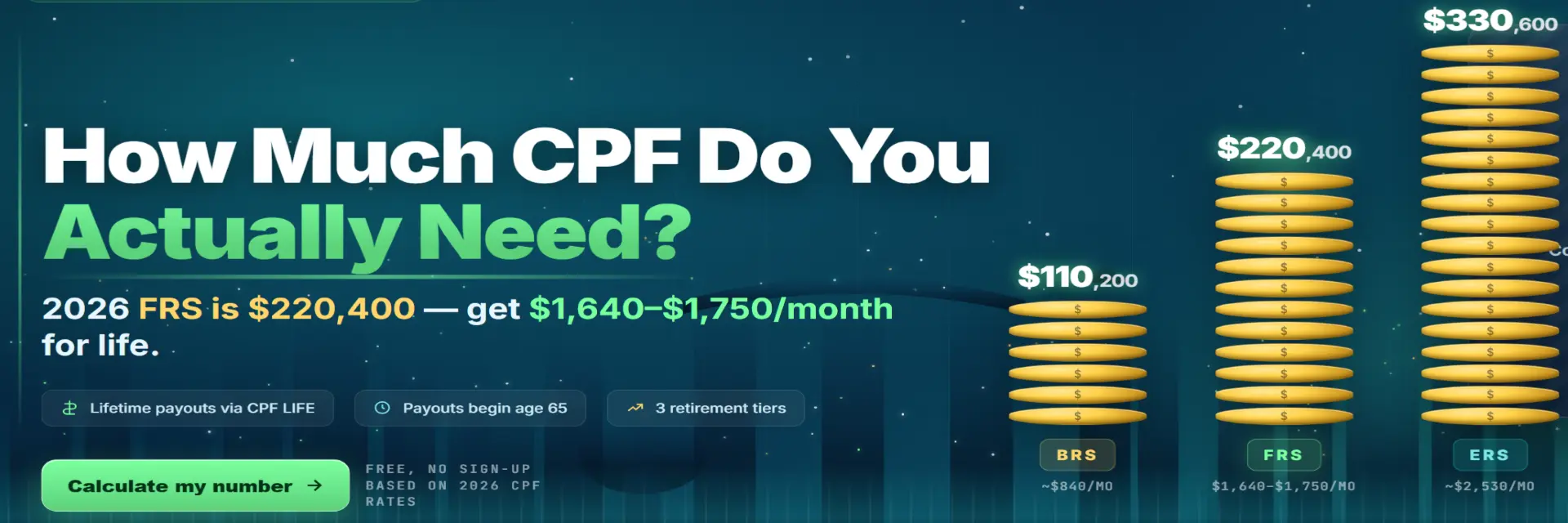
- The Full Retirement Sum (FRS) for 2026 is $220,400 — the standard benchmark for your Retirement Account at 55
- At FRS, CPF LIFE pays out approximately $1,780/month for life from age 65
- At the Basic Retirement Sum (BRS) of $110,200, expect $950/month — workable only if you have a property pledge
- The Enhanced Retirement Sum (ERS) for 2026 is $440,800 — producing about $3,440/month from age 65
- Every dollar of cash top-up to your SA before 55 earns 4% p.a. (CPF Board rate, as at 20 August 2026) and qualifies for income tax relief up to $8,000/year
- Use the CPF Calculator to model your own retirement balance projection
The honest answer to "how much do I need?" depends entirely on what kind of retirement you want to fund. But CPF has a built-in structure that gives you a useful anchor: the Retirement Sums.
If you understand what BRS, FRS, and ERS actually mean in terms of monthly cash in your pocket — and you know where you stand today — you can work out how much of the gap to close before 55.
The full table, including the figure for every cohort from 2017 onwards, is in the CPF retirement sum reference.
The Three Retirement Sum Levels (2026 Figures)
When you turn 55, a Retirement Account (RA) is created and CPF sweeps your Special Account (and some OA) into it up to the prevailing retirement sum. How much ends up in your RA determines what CPF LIFE pays you from 65.
| Retirement Sum | 2026 Amount | Monthly CPF LIFE Payout (from 65) | Who It's For |
|---|---|---|---|
| Basic Retirement Sum (BRS) | $110,200 | ~ $950/month | Those with a property pledge |
| Full Retirement Sum (FRS) | $220,400 | ~ $1,780/month | Most Singaporeans — the default target |
| Enhanced Retirement Sum (ERS) | $440,800 | ~ $3,440/month | Those who want maximum payout |
Source: CPF Board, cpf.gov.sg. Monthly payout figures are indicative and based on the CPF LIFE Standard Plan for members turning 55 in 2026.
The BRS is exactly half of FRS. You can retain BRS in your RA — rather than FRS — only if you own a property with a remaining lease that covers your lifetime, since the property acts as a safety net. If you have no qualifying property, FRS is the floor.
The ERS is exactly four times the BRS (raised from 3× to 4× in 2025) and allows Singaporeans to set aside more voluntarily for a higher monthly payout for life. The FRS is the standard target.
See exactly where you stand today relative to FRS and how top-ups change your trajectory.
Run Your Retirement Projection →What Does BRS Actually Buy You?
$950/month doesn't go far in Singapore, particularly if you're renting or have any significant ongoing health costs. This is the level designed as a supplement to property proceeds — not a standalone retirement income.
For context:
- Average 1-bedroom HDB rental in 2026: approximately $1,500–$2,000/month
- Government household expenditure surveys put basic monthly living expenses for a single retiree around $1,300–$1,500
BRS is a floor, not a target.
The FRS as a Benchmark
$1,780/month covers modest living expenses and healthcare costs, particularly if you own your home outright. For many Singaporeans in paid-off HDB flats, FRS-funded CPF LIFE can serve as the core of retirement income, alongside any personal savings, SRS, or rental income. If you haven't bought yet, run the housing side first: the HDB Affordability Calculator shows your maximum loan and monthly mortgage commitment so you can size the housing cost against your CPF retirement target.
The 2026 FRS of $220,400 in your RA at 55, left to compound at 4% p.a. until payout starts at 65, becomes approximately $337,051 by the time CPF LIFE kicks in. That pool, structured as a life annuity, is what generates the $1,780/month figure.
If you want more — which is reasonable — the ERS at $440,800 generates about $3,440/month . That requires either a much larger CPF balance at 55, significant top-ups, or both.
Worked Example 1: Rachel, 40, Employed
Rachel is 40 years old, Singapore Citizen, earning $6,000/month. Her CPF balances today:
| Account | Balance |
|---|---|
| Ordinary Account (OA) | $105,000 |
| Special Account (SA) | $55,000 |
| MediSave Account (MA) | $20,000 |
| Total CPF | $180,000 |
Step 1: Project SA balance at 55 (15 years away)
Rachel's SA earns 4% p.a. She also receives ongoing monthly CPF contributions into SA. On a salary of $6,000, the SA share of her wage rises with age: 7% up to 45, 8% from 46 to 50 and 11.5% from 51 to 55.
- Up to 45: $6,000 × 7% = $420/month, or $5,040/year
- 46 to 50: $6,000 × 8% = $480/month, or $5,760/year
- 51 to 55: $6,000 × 11.5% = $690/month, or $8,280/year
- Projected SA balance at 55: approximately $218,000 (starting from $55,000, 4% p.a. on the year-end balance, contributions added at year end, salary held flat, extra interest ignored)
Step 2: Assess her position relative to FRS
| Item | Amount |
|---|---|
| Projected SA at 55 | ~$218,000 |
| Estimated FRS when Rachel turns 55 in 2041 (~3.5% annual increase) | ~$369,000 (estimated) |
| Gap to FRS | ~$151,000 |
On these figures Rachel's gap is about $151,000. It counts SA alone; her OA can also be used to fund the RA at 55. The rest would have to come from voluntary SA top-ups, OA contributions, or other retirement savings (SRS, property equity).
Step 3: What does a voluntary SA top-up do?
If Rachel makes an $8,000 cash top-up to her SA each year for the next 15 years:
- Total top-ups: $120,000 cash invested
- At 4% p.a. compounded over 15 years (each top-up made at year end), this adds approximately $160,000 to her SA balance by 55
- Tax relief on each year's $8,000 top-up: An $8,000 cash top-up saves $560 in tax on a chargeable income between $40,000 and $80,000, and $920 between $80,000 and $120,000 — so the real cost is $7,440 or $7,080 respectively. Chargeable income is your pay after CPF contributions, which are not taxed, and after any other reliefs.
On these figures the top-ups would cover the gap, and after tax relief they cost less than they appear to.
Worked Example 2: Ahmad, 50, Self-Employed
Ahmad is 50 years old, a self-employed consultant earning $80,000 in Net Trade Income per year. As a self-employed person, Ahmad has no mandatory OA or SA contributions — only compulsory MediSave contributions of approximately $8,400/year.
His CPF balances today:
| Account | Balance |
|---|---|
| Ordinary Account (OA) | $18,000 |
| Special Account (SA) | $42,000 |
| MediSave Account (MA) | $51,000 |
| Total CPF | $111,000 |
Ahmad has 5 years until he turns 55. His situation:
- If he does nothing: SA of ~$42,000 grows at 4% to ~$51,000 by 55 — well short of even BRS ($110,200)
- If he contributes the maximum $8,000 cash top-up to SA every year for 5 years: that adds ~$43,300 at 4% over 5 years (each top-up made at year end) — bringing SA to ~$94,000 at 55
- Still short of FRS, but combined with OA, Ahmad can top up his RA post-55 to close the gap further
Ahmad's lesson: self-employed people accumulate CPF more slowly and need to be more deliberate about voluntary top-ups. The years before 55 matter more for him. He can also make voluntary contributions to OA and SA as a self-employed person.
Making $8,000 SA top-ups annually also saves Ahmad An $8,000 cash top-up saves $560 in tax on a chargeable income between $40,000 and $80,000, and $920 between $80,000 and $120,000 — so the real cost is $7,440 or $7,080 respectively. Chargeable income is your pay after CPF contributions, which are not taxed, and after any other reliefs.
Worked Example: What the Full Retirement Sum Earns and Pays
The short answer: The 2026 Full Retirement Sum of $220,400 left untouched from 55 grows to about $337,051.34 by 65, and pays $1,780 a month for life from then.
| Step | Working | Figure |
|---|---|---|
| Retirement Account at 55, set aside at the 2026 Full Retirement Sum | CPF Board, members turning 55 this year | $220,400 |
| Base interest | Retirement Account floor rate | 4% |
| Extra interest | +2% on the first $30,000 and +1% on the next $30,000 of combined balances | 4.41% overall in year one |
| Retirement Account at 65 | 10 years of interest, no withdrawals and no further top-ups | $337,051.34 |
| Interest earned between 55 and 65 | $337,051.34 − $220,400 | $116,651.34 |
| CPF LIFE payout from 65 | Standard Plan, for a member who set aside the 2026 Full Retirement Sum | $1,780 a month |
| Payouts over 20 years | $1,780 × 12 × 20 | $427,200 |
| Payouts as a share of the sum set aside | $21,360 a year against $220,400 | 9.7% a year |
How this was computed: Interest applies CPF’s published tiers each year: the floor rate on the whole balance plus 2% on the first $30,000 and 1% on the next $30,000, which is why the effective rate is 4.41% and not a flat 4%. The payout is CPF Board’s own estimate for this cohort on the Standard Plan — CPF LIFE Standard Plan, 4% interest, payouts from age 65, for members turning 55 in 2026. Payouts for life are not capped at 20 years; that row exists only to show the scale.
How Much CPF Do You Actually Need? A Framework
| Monthly Retirement Income Target | CPF LIFE Portion | Gap to Fund Elsewhere |
|---|---|---|
| $1,500/month | BRS payout | About $550/month from savings/rental |
| $2,000/month | ~FRS payout | Minimal gap if you hit FRS |
| $3,000/month | ~ERS payout | Small gap if you hit ERS |
| $4,000+/month | Exceeds CPF LIFE | Significant personal savings needed |
If your retirement income target is $2,000/month and CPF LIFE at FRS pays $1,780/month, your gap is about $220/month — which modest personal savings can cover. If your target is $4,000/month, CPF LIFE is a foundation, not the solution.
What Starting Age Does to the Cost
In a retirement projection, your current age drives much of the result. CPF Board sets the SA rate at 4% (as at 20 August 2026), with no market risk.
Consider two people who both aim for the 2026 FRS of $220,400 at 55:
| Start SA top-ups at 35 | Start SA top-ups at 45 | |
|---|---|---|
| Years of compounding | 20 | 10 |
| Annual top-up needed | ~$7,400 | ~$18,400 |
| Total cash invested | ~$148,000 | ~$183,600 |
The figures assume 4% p.a., each top-up made at year end, an SA balance of zero at the start, and a target of $220,400 at 55. The person who starts at 35 invests less total cash to hit the same target. The earlier you act, the lower the actual cost.
What Topping Up Does to Your CPF LIFE Payout
CPF Board's estimates put the payout at $950/month for the BRS ($110,200) and $1,780/month for the FRS ($220,400). The extra $110,200 between them adds $830/month, or about $75 for every $10,000 more in your RA at 55 (2026 cohort, Standard Plan).
If you're at $180,000 RA at 55 and top up $40,400 more to reach the FRS of $220,400, the additional payout is about $300/month on that same slope, for life.
Action Checklist
- Log into my.cpf.gov.sg and note your exact OA, SA, and MA balances today
- Calculate your current SA trajectory — how much flows in monthly and at what rate of growth
- Estimate the FRS when you turn 55 (use ~3.5% annual increase as a working estimate)
- Calculate your gap between projected SA + RA and the estimated FRS
- Model a voluntary SA top-up — even $3,000–$5,000/year makes a measurable difference
- Check your income tax rate to quantify the actual after-tax cost of SA top-ups
- Run your personalised projection through the CPF Calculator
- Decide on a recurring annual top-up before December 31 each year to claim the year's tax relief
The size of your own gap depends on your balances and your age, which is what this checklist helps you work out. SA top-ups are only possible before 55.
Frequently Asked Questions
What is the Full Retirement Sum for 2026?
The Full Retirement Sum (FRS) for Singaporeans turning 55 in 2026 is $220,400. It is the standard amount set aside in your Retirement Account to fund CPF LIFE payouts from age 65, and it is two times the Basic Retirement Sum ($110,200).
What if I can't hit the FRS by 55?
There is no penalty for falling short of the FRS. Your CPF LIFE payout reflects your actual Retirement Account balance. After 55 you can keep topping up your Retirement Account (the Special Account closes at 55) to raise your balance and payout. If you own qualifying property you can pledge it and set aside the BRS instead of the FRS.
Does my property count toward retirement adequacy?
Indirectly. If you own a property with a remaining lease that covers you to at least age 95, you can pledge it to CPF and set aside only the BRS ($110,200) instead of the FRS ($220,400) in your Retirement Account. The property is a safety net; it does not add to CPF LIFE payouts.
Can I use SRS to supplement CPF toward retirement?
Yes, SRS is a complementary vehicle. CPF Board sets the Special and Retirement Account floor rate at 4% (as at 20 August 2026) and cash top-ups qualify for relief of up to $8,000 a year, so many people look at CPF first. SRS is a second option, mainly for those with chargeable income above $80,000, where the marginal tax rate rises from 7% to 11.5%. See our CPF vs SRS comparison article for the full breakdown.
Is the ERS really $440,800? I have seen different figures.
Yes, $440,800 is the 2026 figure. The Enhanced Retirement Sum was 3 times the BRS until 2024 ($308,700 in 2024) and has been 4 times the BRS since 1 January 2025 ($426,000 in 2025). An article that quotes 3 times the BRS is out of date.
How much will the FRS be by the time I turn 55?
CPF Board publishes it one cohort at a time: $220,400 for 2026 and $228,200 for 2027, a rise of about 3.5%. It does not publish future figures. As an illustration only, at 3% to 3.5% a year the FRS for someone turning 55 in 2031 would be about $256,000 to $262,000. Use the CPF Calculator to project your own trajectory.
What is the difference between the Standard Plan and the Basic Plan for CPF LIFE?
The Standard Plan pays higher monthly amounts and leaves a smaller bequest to nominees on death. The Basic Plan pays lower monthly amounts and preserves more residual value for beneficiaries. The payout figures on this page are for the Standard Plan.
Written by the team at CPF Calculator SG. We build free, accurate tools to help Singaporeans master their CPF. Reviewed against CPF Board policies effective January 2026. For the authoritative source, visit cpf.gov.sg. This article is for general information only and does not constitute financial advice.