Key Takeaways
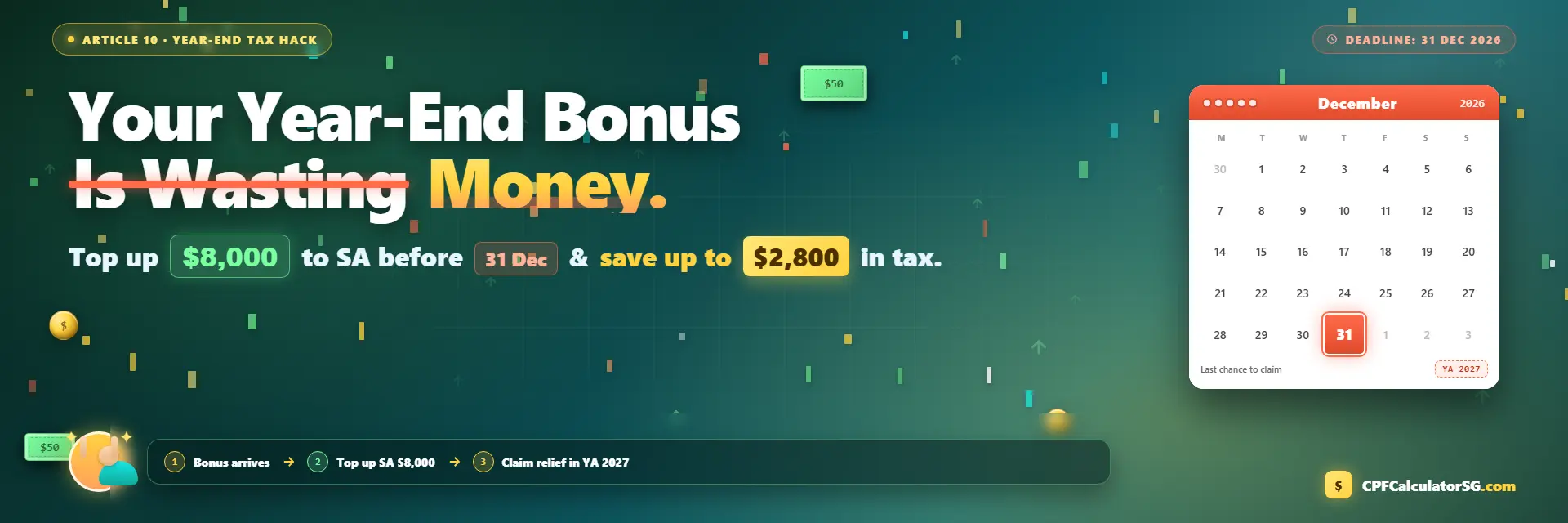
- Top up $8,000 to your SA before December 31 and save up to $1,920 in income tax this year
- Year-end bonuses are subject to CPF under the Annual Wage Ceiling of $102,000 — automatic contributions apply, but voluntary cash top-ups are a separate choice on top of that
- Voluntary cash top-ups to SA/RA qualify for income tax relief of up to $8,000/year for yourself and $8,000/year for family members under the RSTU Scheme
- The top-up must be received by CPF Board by 31 December — online transfers take 1–3 business days; safe deadline is December 24
- If your SA balance is approaching the Full Retirement Sum of $220,400, check your balance first — top-ups via RSTU stop at FRS
The December 31 Cut-Off
Top up $8,000 to your Special Account (or Retirement Account if you are over 55) before 31 December to reduce your chargeable income for the year by $8,000. On an income between $80,000 and $120,000 that is $920 of tax saved; at the top rate of 24% it is $1,920. The money earns the 4% floor rate from the day it lands.
Online CPF top-ups take 1–3 business days. Safe deadline: December 24. Leaving it to the final days of December risks missing the cut-off.
The Tax Saving: A Concrete Worked Example
The short answer: Priya’s $8,000 top-up costs her $7,080 after tax relief, and is worth $15,583.20 in her Special Account by age 55.
| Step | Working | Figure |
|---|---|---|
| Ordinary Wages for the year | $7,500 × 12 | $90,000 |
| Additional Wage ceiling (2026) | $102,000 − $90,000 of Ordinary Wages | $12,000 |
| Bonus that attracts CPF | $15,000 bonus, capped at $12,000 | $12,000 |
| Employee CPF deducted from the bonus | 20% × $12,000 | $2,400 |
| Bonus left in hand | $15,000 − $2,400 | $12,600 |
| Voluntary cash top-up to her own Special Account | Self top-up relief is capped at $8,000 a year | $8,000 |
| Chargeable income before the top-up | Her pay after CPF relief and personal reliefs | $90,000 |
| Income tax on that | IRAS resident rates on $90,000 | $4,500 |
| Income tax after claiming the relief | IRAS resident rates on $82,000 | $3,580 |
| Tax saved | $4,500 − $3,580 | $920 |
| Real cost of the top-up | $8,000 − $920 | $7,080 |
| What that $8,000 is worth at 55 | 4% a year for 17 years, no further top-ups | $15,583.20 |
How this was computed: Priya is 38 and earns $7,500 a month. The CPF steps use gross wages, which is what the Additional Wage ceiling is measured against; the tax steps use chargeable income, which is already net of CPF contributions — they are not taxed — and of any other reliefs. Her marginal rate on the last dollar of $90,000 is 11.5% — the tax saved is the difference between two IRAS tax computations, not the top-up times her marginal rate, because a large enough relief drops income into a lower band. Interest is the Special Account floor rate held flat; CPF’s extra interest on the first $60,000 of combined balances is ignored, so the age-55 figure is the conservative one.
How Bonuses Work in the CPF System
Your bonus is classified as an Additional Wage (AW) by CPF Board. The Annual Wage Ceiling is $102,000 for CPF contribution purposes.
The formula: mandatory CPF contributions apply to additional wages up to $102,000 minus your Ordinary Wages received that year. Your payroll system handles this calculation automatically. The voluntary top-up is entirely separate.
Higher Earners Save Even More
| Marginal rate | Chargeable income | Tax saved on $8,000 |
|---|---|---|
| 2% | $20,000 to $30,000 | $160 |
| 3.5% | $30,000 to $40,000 | $280 |
| 7% | $40,000 to $80,000 | $560 |
| 11.5% | $80,000 to $120,000 | $920 |
| 15% | $120,000 to $160,000 | $1,200 |
| 18% | $160,000 to $200,000 | $1,440 |
| 19% | $200,000 to $240,000 | $1,520 |
| 19.5% | $240,000 to $280,000 | $1,560 |
| 20% | $280,000 to $320,000 | $1,600 |
| 22% | $320,000 to $500,000 | $1,760 |
| 23% | $500,000 to $1,000,000 | $1,840 |
| 24% | above $1,000,000 | $1,920 |
How this was computed: IRAS resident rates. The figure holds when the whole $8,000 sits inside the band — that is, when your chargeable income is at least $8,000 above the bottom of it. Closer to the floor of a band, part of the relief lands in the band below and saves less, which is why every worked example on this site computes the saving as the difference between two tax bills rather than as relief times a rate.
What If You Are Already Close to the FRS?
If your SA balance is approaching the Full Retirement Sum of $220,400, there is a limit on how much more you can top up under the RSTU Scheme. Check your balance at my.cpf.gov.sg before initiating a top-up. If you are within $2,000 of FRS, a full $8,000 top-up may be partially rejected.
If you have already met FRS and want to top up further toward the Enhanced Retirement Sum ($440,800), you can do so — but the RSTU tax relief mechanism applies only up to FRS.
Topping Up Your Spouse's Account
Year-end is a natural time to think about your household's total CPF position. If your spouse has a lower income or a gap in their SA balance, you can make a cash top-up to their SA or RA and claim the family tax relief (up to $8,000 combined for all family members, separate from your self-top-up relief).
A total of $16,000 in RSTU relief is possible in a single year ($8,000 self + $8,000 family). See CPF for Couples for the full worked example.
Common Mistakes People Make
- Missing the December 31 deadline. The top-up must be received by CPF Board, not just initiated, by December 31. Safe deadline: December 24.
- Confusing the tax relief with the top-up limit. Only the first $8,000 gets tax relief. The excess still earns 4% in SA but gives no additional income tax benefit.
- Not checking the SA ceiling before topping up. If your SA is within $1,000 of the FRS ($220,400), a full $8,000 top-up may be partially rejected.
- Forgetting about parents. The $8,000 family top-up relief is separate from your self-top-up relief.
How to Make the Top-Up (Step-by-Step)
- Log into my.cpf.gov.sg using Singpass
- Navigate to "Top up my CPF" under the Retirement section
- Select "Top up using cash" under the Retirement Sum Topping-Up Scheme
- Choose the recipient (self, spouse, parents, etc.)
- Enter the amount (up to $8,000 for self-top-up tax relief)
- Complete payment via PayNow, internet banking, or AXS
CPF Board automatically reports top-ups to IRAS, and the relief should appear pre-filled in your tax return.
Check your current SA balance against FRS and see exactly how much room you have to top up.
Check Your SA Balance →Frequently Asked Questions
Can I use my bonus for an OA-to-SA transfer instead of a cash top-up?
You can, but it is a different mechanism and earns no tax relief. A transfer moves money already inside CPF from 2.5% to 4%; only a cash top-up under RSTU reduces your chargeable income. You can do both in the same year.
What if I miss the 31 December deadline?
The top-up counts toward the following year of assessment instead. You have not lost the relief, you have delayed it by twelve months.
Does an SA top-up count toward my FRS target?
Yes. Any RSTU cash top-up increases your Special Account balance, which counts toward the Full Retirement Sum of $220,400 that is set aside in your Retirement Account at 55.
Can I contribute to both CPF RSTU and SRS in the same year?
Yes — they are separate relief categories. RSTU gives up to $8,000 for yourself, and SRS up to $15,300 for a Singapore Citizen or PR. Both can be claimed in the same year, subject to the $80,000 cap on total personal reliefs.
What if I need the $8,000 back before 55?
You cannot have it back. RSTU top-ups to the Special Account cannot be withdrawn before 55. Money you might need before retirement is better kept outside the Special Account.
Written by the team at CPF Calculator SG. Reviewed against CPF Board policies effective January 2026. For the authoritative source, visit cpf.gov.sg. This article is for general information only and does not constitute financial advice.