Key Takeaways
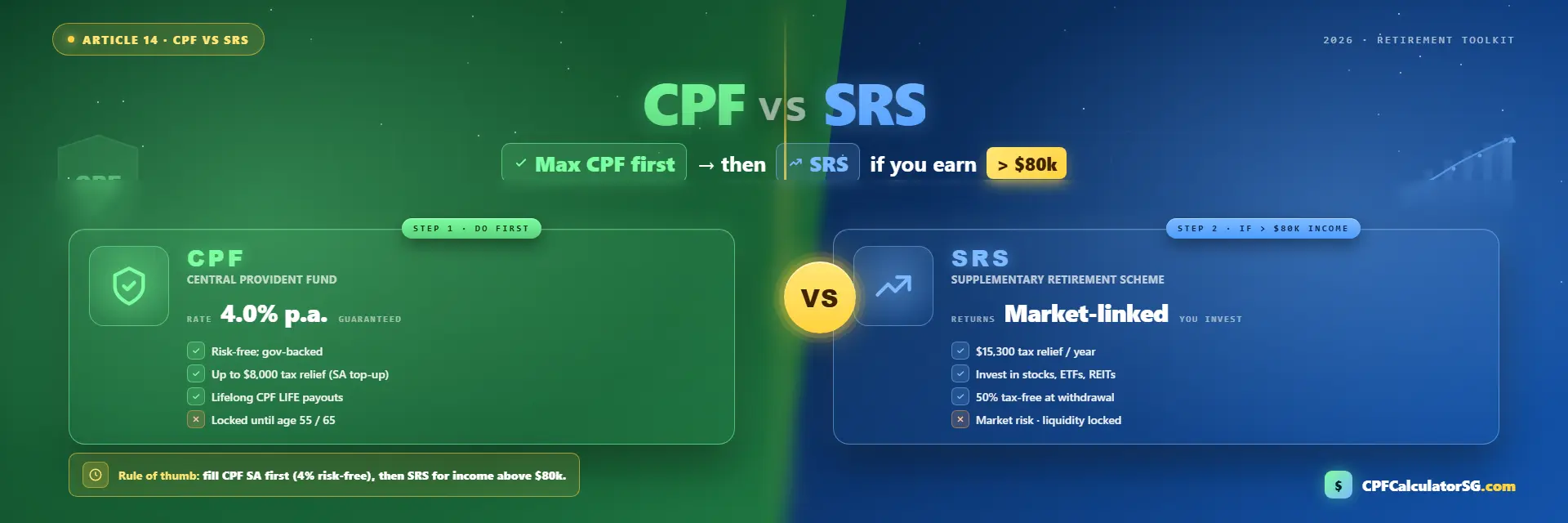
• CPF Board pays 4% a year on SA and RA money (as at 20 August 2026) and runs CPF LIFE, a lifelong annuity; SRS offers investment flexibility but no set return
• SRS withdrawals are 50% taxable; CPF LIFE payouts are not taxed
• Below $80,000 of chargeable income, the SRS tax saving is modest and the lock-up is long, so the case for SRS is weaker
• Above $80,000, SRS adds up to $15,300/year of tax relief on top of the CPF RSTU relief
• One common sequence: top up CPF SA/RA toward FRS ($220,400) first, then consider SRS if your income makes the relief worth the lock-up
• SRS providers are DBS, OCBC, and UOB — you can only hold one account
A Rule of Thumb by Income
Do you earn above $80,000 per year (chargeable income)?
├─ NO  → The CPF RSTU top-up usually carries more of the benefit.
│         The SRS tax saving is small against the lock-up.
│
└─ YES → Both can apply: the CPF RSTU top-up (up to $8,000/year
          to SA or RA) and SRS (up to $15,300/year).
          A higher marginal rate makes the upfront relief larger.
The rest of this article explains why.
CPF: What It Does and What It Doesn't
CPF is government-run, mandatory at its core, and voluntary at the margins. The voluntary component relevant for retirement planning is topping up your SA (before 55) or RA (from 55) with cash — earning 4% p.a. (CPF Board rate, as at 20 August 2026) and qualifying for up to $8,000/year income tax relief under RSTU.
Strengths of CPF
- CPF Board sets and pays the interest, and the balance does not move with markets
- SA and RA earn 4% p.a.; the first $40,000 in SA/RA earns an additional 1% bonus interest (effectively 5%)
- Tax relief on voluntary top-ups: up to $8,000 self + $8,000 for family members
- Automatically converts to CPF LIFE at 65 — a lifelong annuity run by CPF Board
- CPF LIFE payouts are not subject to income tax
Limitations of CPF
- Voluntary top-ups to SA/RA are illiquid — locked until 55 (SA) or 65 (RA/CPF LIFE)
- Contributions go to SA or RA only — cannot be used for housing or medical expenses
- Tax relief capped at $8,000/year for own RSTU top-ups
- Limited investment options (CPF Investment Scheme exists but with restrictions)
SRS: What It Does and What It Doesn't
The Supplementary Retirement Scheme is operated by three banks: DBS, OCBC, and UOB. You open an SRS account, contribute up to the annual limit, and invest in a range of financial products.
Annual contribution limits (2026)
- Singapore Citizens and Permanent Residents: $15,300/year
- Foreigners: $35,700/year
The full amount contributed in any year is deductible from your assessable income — directly reducing your tax bill in the year of contribution.
What you can invest SRS funds in
- SGX stocks and REITs
- Unit trusts and ETFs
- Singapore Government Securities
- Fixed deposits (held within SRS)
- Insurance products (endowment and annuity plans)
At retirement (penalty-free withdrawal from age 63)
- Only 50% of each withdrawal is included in your assessable income for tax
- You have up to 10 years to draw down — spreading withdrawals lets you manage the taxable portion each year
- If your income is low in retirement, the effective tax on SRS withdrawals may be near zero
Early withdrawal (before age 63)
- The full withdrawal amount is taxable (not just 50%)
- A 5% penalty applies on top
Side-by-Side Comparison
| Feature | CPF SA/RA Top-Up (RSTU) | SRS |
|---|---|---|
| Annual relief limit | $8,000/year (self) | $15,300/year (SC/PR); $35,700 (foreigner) |
| Tax relief | Yes — up to $8,000/year | Yes — full contribution amount |
| Return | 4% p.a., set by CPF Board (as at 20 August 2026) | No — depends on investments |
| Investment options | Restricted (CPFIS only) | Broad: stocks, ETFs, FDs, insurance |
| Early withdrawal | Not allowed before 55 (SA) | Allowed, but 5% penalty + full tax |
| Penalty-free access | 55 (lump sum above FRS); 65+ (CPF LIFE) | Age 63 |
| Tax on withdrawals | CPF LIFE payouts not taxed | 50% of withdrawal is taxable |
| Who holds the money | CPF Board | No — bank-held, market-dependent |
| Annuity option | Built-in via CPF LIFE (lifelong) | Optional — purchase separately |
| Providers | CPF Board | DBS, OCBC, UOB |
Sources: CPF Board (cpf.gov.sg), IRAS (iras.gov.sg).
Who Actually Benefits from SRS?
If you earn below $80,000
SRS is a weaker priority here. At $60,000 chargeable income, your marginal tax rate is around 7%. Contributing $15,300 to SRS saves you approximately $1,071 in tax that year. In exchange, you lock up $15,300 for potentially 20–30 years, with investment returns not set in advance and 50% of withdrawals taxable when you retire. The upfront benefit is real but modest. In this bracket the $8,000 CPF RSTU top-up earns the CPF Board rate of 4% a year (as at 20 August 2026) instead of a market return, so the comparison often turns on whether you value a set rate over investment choice.
If you earn above $80,000
The case for SRS gets stronger. At $120,000 chargeable income, your effective marginal rate on the SRS deduction is around 15–20%. Contributing $15,300 saves you approximately $2,300–$3,000 in tax that year. Combined with compounded investment growth over decades and the 50% tax inclusion on withdrawal (when your income may be much lower), SRS can add compounding growth, though the return depends on what you invest in.
Worked Example: $120,000 Earner
The short answer: On a $120,000 income the SRS cap of $15,300 saves $1,759.50 in tax and the $8,000 CPF top-up saves $920 — but only the CPF money earns the CPF Board rate of 4% a year.
| Step | Working | Figure |
|---|---|---|
| Chargeable income before any relief | No other reliefs assumed | $120,000 |
| Income tax on that | IRAS resident rates | $7,950 |
| Route A — contribute the SRS cap | 15% of $102,000 for a citizen or PR | $15,300 |
| Tax after the SRS relief | Tax on $104,700 | $6,190.50 |
| Tax saved, Route A | $7,950 − $6,190.50 | $1,759.50 |
| Route B — cash top-up to your own Special Account | Capped at $8,000 a year | $8,000 |
| Tax after the CPF relief | Tax on $112,000 | $7,030 |
| Tax saved, Route B | $7,950 − $7,030 | $920 |
| Both routes together | $15,300 + $8,000 of relief | $2,679.50 saved |
| What the money then does | CPF pays a floor of 4% and is locked to 55; SRS earns nothing until you invest it yourself | — |
| Tax at the other end | CPF withdrawals are not taxed; 50% of an SRS withdrawal is, spread over 10 years from age 63 | $40,000 a year tax-free with no other income |
How this was computed: IRAS resident rates, no other reliefs, and the personal income tax relief cap of $80,000 is not reached. The $40,000 figure is derived, not quoted: only 50% of a withdrawal made at or after the prescribed retirement age is chargeable, and the first $20,000 of chargeable income is taxed at nil.
One Common Sequence: CPF First, Then SRS
This is the order the rest of the page assumes. Whether it fits depends on your income, your age and what else you hold.
Step 1: CPF SA/RA top-up toward FRS ($220,400 in 2026)
- The CPF Board rate is 4% a year, with no market risk
- Tax relief of up to $8,000/year on own top-ups
- Converts automatically to CPF LIFE, a lifelong income
Step 2: SRS, where income is above $80,000
- Additional $15,300/year in tax relief (on top of CPF RSTU)
- Use SRS for diversified investments — stocks, ETFs, or insurance products
- CPF LIFE gives an income floor; SRS investments add growth potential, with the risk that comes with it
Step 3: MediSave top-up
- If your MediSave Account is below the Basic Healthcare Sum ($79,000 in 2026), topping it up also earns the CPF Board rate and qualifies for separate tax relief
Why CPF Often Goes First
CPF LIFE is a lifelong annuity — you cannot outlive it. SRS is not — you draw it down over a chosen period, and if you live longer than expected, the SRS balance depletes. CPF LIFE gives an income floor that SRS does not, which is the main reason this sequence puts CPF first. With that floor in place, SRS funds can act as flexible, supplementary income.
Run your CPF projection and see how top-ups to SA compound toward FRS.
Use the CPF Calculator →A Note for Foreigners: SRS Is the Main Voluntary Option
For foreigners working in Singapore, SRS works differently from the citizen and PR case:
- The annual SRS limit for foreigners is $35,700 — more than double the SC/PR limit
- The penalty-free withdrawal age (63) is the same
- CPF RSTU top-ups are not available to foreigners, so SRS is the primary voluntary retirement vehicle
- Withdrawals after 63 are 50% taxable — if you have left Singapore by then, the effective tax may be very low
Example: A foreigner who is a Singapore tax resident and has $150,000 of chargeable income, with no other reliefs, pays $12,450 in income tax at IRAS resident rates for YA 2024 onwards. Contributing $35,700 to SRS lowers chargeable income to $114,300 and tax to $7,294.50, a saving of $5,155.50 a year. If income and rates stayed the same for 15 years in Singapore, that is about $77,000 in cumulative tax savings, before any investment growth.
SRS Providers: DBS, OCBC, and UOB
You can open an SRS account with any of the three authorised operators. You can only hold one SRS account — switching is possible but requires a transfer process.
| Provider | SRS Account |
|---|---|
| DBS | DBS SRS Account |
| OCBC | OCBC SRS Account |
| UOB | UOB SRS Account |
In practice, the investment products across all three are broadly similar. Choose the bank whose investment platform you find easiest to use — the core SRS mechanics are identical.
Key deadline: SRS contributions must be received by December 31 to count for that tax year. Online transfers take 1–3 business days. A practical deadline: December 24.
The CPF and SRS Blueprint (PDF)
CPF vs SRS compared — with tax saving tables, worked examples, and the step-by-step priority sequence. Free download.
Watch: CPF vs SRS — Where Should Your Money Go?
Frequently Asked Questions
Can I contribute to both CPF RSTU top-ups and SRS in the same year?
Yes. They fall under separate relief categories. CPF RSTU qualifies for up to $8,000 (own account). SRS qualifies for up to $15,300 (SC/PR). Both can be claimed in the same tax year. Note: total personal income tax reliefs are capped at $80,000 per year across all categories — check your position if you claim other reliefs.
Is SRS money safe if the bank fails?
SRS cash deposits are protected up to $75,000 per depositor per bank under the Singapore Deposit Insurance Corporation (SDIC). Investments held in SRS (stocks, unit trusts, etc.) are held in your own name as securities — they are not a bank liability and are not subject to SDIC limits.
Can I use SRS to buy CPF LIFE?
No. CPF LIFE is only available through your CPF Retirement Account. However, you can use SRS funds to purchase private annuity products from insurers, which provides a similar lifelong income function.
What happens to my SRS balance when I die?
Your SRS balance is distributed to your estate according to your will, or under intestacy rules if no will exists. The withdrawal is taxable as income in the year of withdrawal (at the 50% inclusion rate), with the tax liability falling on the estate.
If I open SRS and then leave Singapore, what happens?
If you withdraw SRS funds after leaving Singapore and before age 63, the full amount is taxable plus a 5% penalty. If you wait until 63, the normal 50% inclusion rate applies — even if you are no longer a Singapore tax resident. For foreigners planning to leave, timing the start of withdrawals at 63 is important.
Does the $80,000 income threshold apply exactly?
The $80,000 figure is a useful rule of thumb — it marks roughly where the marginal tax rate makes SRS meaningfully worthwhile. Your specific break-even depends on your exact income, other reliefs you claim, and expected retirement income. If in doubt, model your tax saving before committing.
Written by the team at CPF Calculator SG. Reviewed against CPF Board policies effective January 2026. CPF figures based on CPF Board published rates effective January 2026. SRS figures based on IRAS published limits for Year of Assessment 2026. For authoritative guidance, visit iras.gov.sg and cpf.gov.sg. This article is for general information only and does not constitute financial advice.